

In short: A kit list is a record of the equipment you own and take to jobs. The insurance schedule is the part of that list your insurer covers, with a value for each item. Record each item's make, model, serial number, date of purchase and replacement value, then total them. Update the list after every purchase and send a copy to your insurer.
A kit list tells you what you own, and the insurance schedule tells your insurer what they are covering. Keep them as one document, so the list you use on a job is the list you have given the insurer. Most gaps in cover come from items that were bought and never added, or from kit that travels without being on the list.
What the list is for
The list supports three things: the insurance schedule, the proof of ownership if something is lost or damaged, and the check at the start and end of a job, so you know what has gone out and what has come back. It is also what you show a production when they ask what you bring.
Get the template
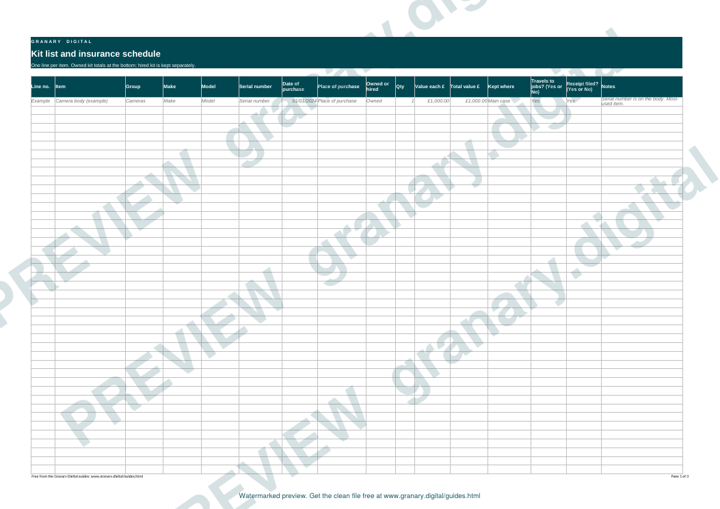
The preview is free to look at and print. For the clean file, without the watermark, put your email in and we will send a download link straight away. You also join From the Barn, our monthly studio email, which you can leave whenever you like.
Open the watermarked preview (PDF)
Done. The download link is on its way to your inbox and works for 7 days. If it has not arrived in a few minutes, check your spam folder.
How to fill it in, step by step
- Walk round the kit, the bags, the van and the storage. Write down everything you own that you use on a job.
- Give each item its own line with a number. Group the lines by type, such as cameras, lenses, lights, sound and cases.
- Record the make, model and serial number. Serial numbers are the fastest way to prove an item is yours.
- Add the date and place of purchase, and keep the receipt in a folder with the list.
- Record the value your insurer asks for. Confirm the basis with them before you start.
- Note where each item is kept, and whether it travels to jobs or stays in storage.
- Add the total at the bottom, and check it against the policy.
- Photograph the main items and the cases, and keep the photographs with the list.
- Update the list after every purchase, sale or repair, and send the changed schedule to your insurer.
Worked example
A freelance camera operator with one camera body, two lenses, a tripod, a monitor, a microphone and a set of batteries.
- Line 01, camera body: make and model, serial number, bought in 2024, value as the insurer asks, kept in the main case, travels.
- Line 02, lens: the same details, with a note that it is the lens used most often.
- Line 03, monitor: serial number from the back of the unit, kept in storage, travels only on jobs that need it.
- Line 04, batteries: a count of six, grouped as one line, with a note of the total value.
- Total: the sum of the values, which the insurer checks against the policy.
When the operator buys a new lens, the new line goes on the list and the schedule goes to the insurer the same week.
Common mistakes
- Leaving out cables, batteries, cases and mounts, which add up to a large value.
- Forgetting kit that travels in a van or a second bag.
- Using the purchase price when the insurer asks for replacement value, or the other way round.
- Not recording serial numbers, which makes a claim harder to prove.
- Adding new kit to the list but not sending the schedule to the insurer.
- Not reading the policy limits. Check the single-item limit, whether kit left in a vehicle is covered and whether cover applies abroad, before the job rather than after a loss.
- Hired kit on the list as if it were owned. Keep hired items on a separate line with the hire company's details.
For how crew work with the kit they bring, see what does a camera operator do?
Related guides
Questions we get asked
What is an insurance schedule for equipment?
It is a list of the items an insurer covers, with a value for each one. The insurer uses it to set cover and to check a claim. Your broker or insurer decides the format and the value basis they want.
Should the kit list use purchase price or replacement value?
Ask your insurer or broker which value they want. Many ask for the cost of replacing each item with a similar one, but the basis must come from them rather than from this page.
What should a freelance kit list include?
Each item's description, make, model, serial number, date of purchase, value, where it is kept and whether it travels. Add cables, batteries, cases and hired kit, and keep receipts with the list.
granary.digital · 01243 884993 · studio@granary.digital · The Old Grainstore, Adsdean, Chichester, West Sussex, PO18 9DN · Prices exclude VAT unless marked inc VAT