

Read the transcript
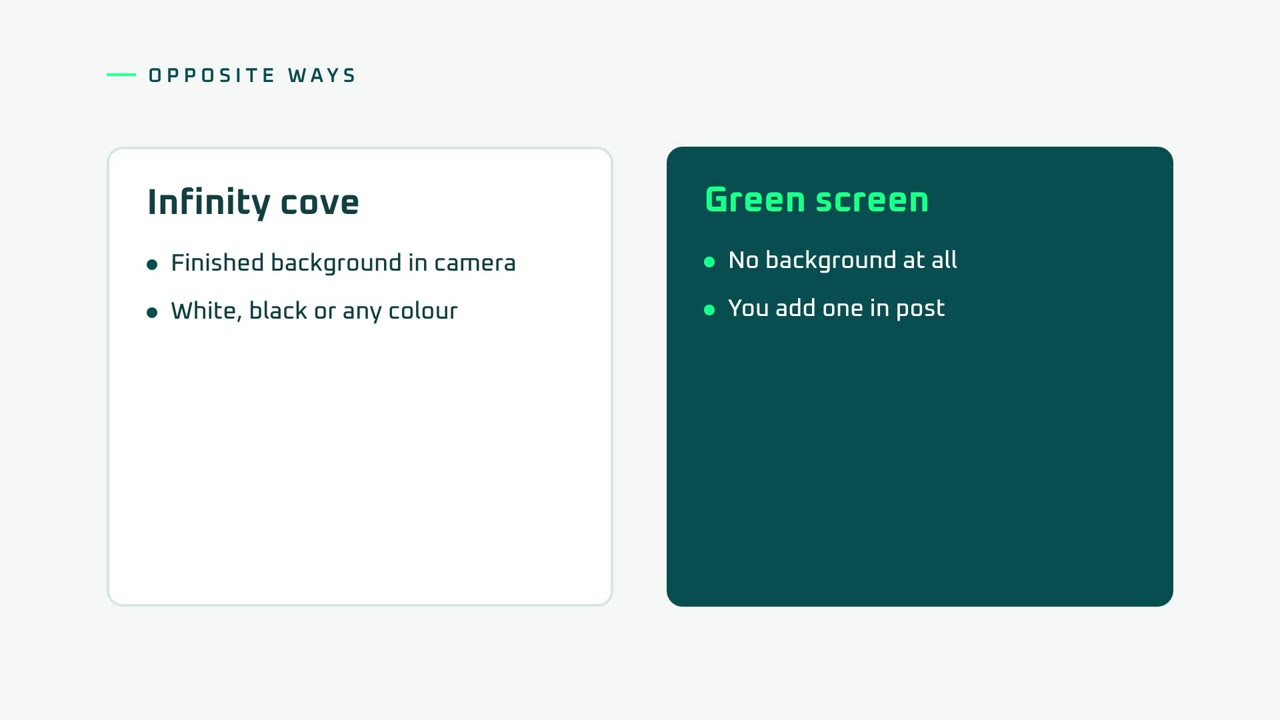
Infinity cove or green screen? Both give you a clean background, and they get there in opposite ways. A cove gives you a real, finished background in camera: white, black, or any colour you light it. A green screen gives you no background at all. You add one in post. So, if the final image exists in the real world, shoot the cove. If it exists in a computer, shoot green. Product, fashion, portraits and vehicles go on the cove. A presenter with slides or graphics behind goes on green. On cost, the cove costs more per hour and less per finished minute. Green is the reverse: cheaper to hire, with a keying cost on every shot. And you can have both. Catalogue on the cove in the morning, presenter inserts on green after lunch. One building, one invoice. Granary Digital. A working studio since 2005.
The one-paragraph answer
An infinity cove gives you a real, finished background in camera: white, black, or any colour you light it. A green screen gives you no background at all; you add one in post-production. If the final image exists in the real world, shoot the cove. If the final image exists in a computer, shoot green.
What an infinity cove is
A cove (also called an infinity curve) is a wall that curves into the floor with no visible join, so the background reads as endless. Ours is two walls, 5.3m × 7.1m, with a return on a third wall. What you see through the lens is the deliverable: clean white for catalogue, gel washes for music videos, full black with the curtain track drawn. There is no keying, no spill, no post cost attached to the background.
What a green screen is
A chroma stage is a promise to the edit. The even green is removed in software and replaced with whatever the brief needs: slides, virtual sets, the moon. Our Green Space is pre-lit specifically for an even key, which is the whole battle; a badly lit green screen costs more to fix than it saved to hire.
How to choose
- Product, fashion, portraits, vehicles: cove. The background is part of the photography.
- Presenter with slides or graphics behind: green screen. The background is part of the edit.
- Music videos: usually cove, lit for colour. Green only if the concept is digital worlds.
- Drama: neither; build a set. See set building.
- Budget rule: the cove costs more per hour and less per finished minute. Green is the reverse: cheaper to hire, with a keying cost on every shot.
Can you have both?
Yes. The White Space rigs with chromakey curtains when a production needs full-body or group keying beyond the Green Space's 3.6m stage. Some shoots run both in one day: catalogue on the cove in the morning, presenter inserts on green after lunch. One building, one invoice.
Cove versus a backdrop
The other thing people compare a cove with is a backdrop: a paper roll or a fabric drop on a stand, which is what most photography studios mean by "white background". They are not the same product, and the difference is where the wall meets the floor.
- The floor line. A paper roll is pulled out across the floor and creases where it turns. Feet, wheels and stands crease it further. A cove has a 70cm-radius plaster sweep with no join; there is no floor line to retouch because there is no floor line.
- Width. Paper rolls are 1.35m or 2.72m wide. Two people full-length use all of the wide one; a car or a group of six cannot be lit clean on white in front of it. Our cove is 5.3m wide and 7.1m deep, two walls and a return, so a group or a car fits with white to the edge of frame.
- Spill and evenness. A drop is lit from the front and falls off towards its edges. A cove is lit from the grid along the sweep (sixteen 500W floods on ours) and reads even from the top of the wall to the front of the floor, which is why it needs no masking afterwards.
- Movement. Turn the camera in front of a backdrop and the edge appears. On a two-wall cove the background stays clean through about a quarter turn.
- Wear. Paper tears and gets replaced roll by roll. The cove is repainted every three months, included in the hire.
A backdrop is right for headshots, small product and anything that fits in two metres of width on a budget. Beyond that, it costs you in post or in compromise. The measurements of ours are in what is an infinity cove? and how it is lit in lighting a cove.
granary.digital · 01243 884993 · studio@granary.digital · The Old Grainstore, Adsdean, Chichester, West Sussex, PO18 9DN · Prices exclude VAT unless marked inc VAT