

In short: A cue sheet lists every piece of music in a programme, with its title, writers, publishers, how it is used and how long it runs. Fill one in as you edit, time each cue from the locked picture, and keep it with your licences. Check the current PRS for Music guidance and the broadcaster's own requirements before you submit it.
A cue sheet records how each piece of music is used in a production. PRS for Music describes it as the primary source for allocating usage to the music used, so the details matter. A sheet with a missing writer or a wrong duration can delay royalties or send them to the wrong people.
What goes on the sheet
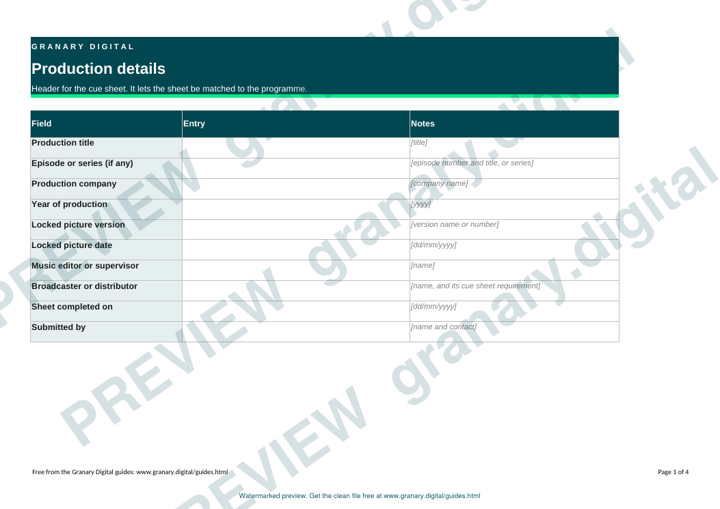
- Production details: the title, the episode or series if there is one, the production company and the year.
- Each cue: its title, and its catalogue number where there is one.
- Writers and publishers: for each cue, including arrangers.
- Usage: whether the music is featured, meaning it is the point of the moment, or background, meaning it sits under dialogue or action.
- Duration: the length of each cue, from the locked picture.
- Type of music: library, pre-existing or commissioned.
- Codes: an ISRC or Tunecode where you have one.
Get the template
The preview is free to look at and print. For the clean file, without the watermark, put your email in and we will send a download link straight away. You also join From the Barn, our monthly studio email, which you can leave whenever you like.
Open the watermarked preview (PDF)
Done. The download link is on its way to your inbox and works for 7 days. If it has not arrived in a few minutes, check your spam folder.
How to fill it in
- Add a line for every piece of music as you edit it, including temporary music that stays in the cut.
- Write the title exactly as the library or release names it.
- Take the writers and publishers from the licence or the library catalogue. Do not guess them.
- Mark each cue as featured or background at the point it is placed in the film.
- Time each cue from the final locked picture. The length of the source track is not the length in the film.
- Keep the finished sheet with the licences and the final mix.
Worked example
A six-minute short has three cues. A library track runs under the opening titles and is marked featured. A commissioned score sits under the middle section and is marked background. A pre-existing song plays on a radio in one scene and is also marked background. Each line carries the writer and publisher from the paperwork, and the duration is taken from the locked cut, so the sheet still matches the film after the last trim.
Common mistakes
- Leaving out a writer or publisher because the track was downloaded from a website.
- Timing from the track file, so the cue length is wrong after the edit trims it.
- Forgetting music heard in the scene, such as a radio, a phone or a playing television.
- Confusing the library name with the track title.
- Sending a sheet with no production details, so it cannot be matched to the programme.
For background on clearing and licensing the music itself, read the music licensing guide for filmmakers before you lock the edit.
Sources
- PRS for Music, Cue sheets: a simple guide (2012 draft), read 5 November 2026
Related guides
Questions we get asked
What is a music cue sheet?
A list of every piece of music in a programme, with the title, writers, publishers, usage and duration of each cue. It lets royalties reach the right writers and publishers.
Who sends the cue sheet for a broadcast?
For a commissioned programme the production company usually supplies the cue sheet as part of delivery, and the broadcaster uses it to report the music it has used. Check the broadcaster's delivery requirements before you assume.
Do I need a cue sheet for festivals?
Ask the festival, distributor or sales agent what it needs, because requirements vary. A complete sheet costs little to keep and makes a later sale simpler.
granary.digital · 01243 884993 · studio@granary.digital · The Old Grainstore, Adsdean, Chichester, West Sussex, PO18 9DN · Prices exclude VAT unless marked inc VAT