

In short: Settle the terms before anyone records. Cover who is consenting, what is covered (recording, editing, a synthetic voice or AI footage of a face), which uses, where and for how long, approval of the output, fees for each new use, labelling, and how the person can withdraw or request removal. Each new use is a new permission, so a recording session is not a licence for everything that follows.
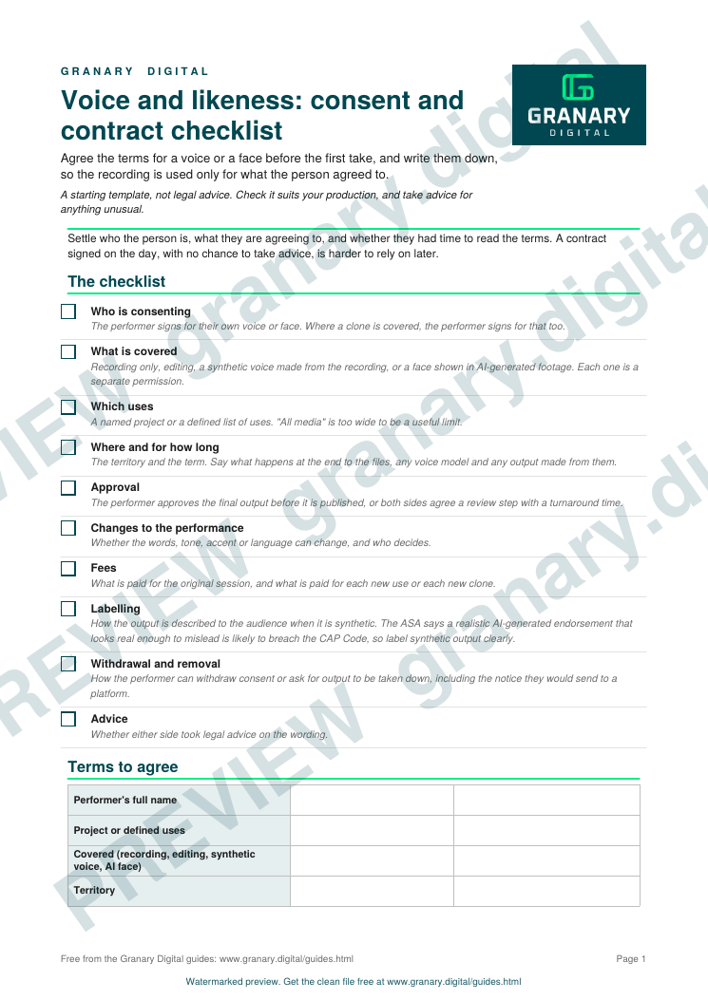
Agree the terms for a voice or a face before the first take, and write them down. The checklist below covers what to settle and in what order, so that a voiceover, a clone or a face in AI footage can be used only for what the person agreed to.
Before you record anything
Settle three things first: who the person is, what they are agreeing to, and whether they had time to read the terms. A recording made under pressure, or a contract signed on the day with no chance to take advice, is harder to rely on later.
Get the checklist
The preview is free to look at and print. For the clean file, without the watermark, put your email in and we will send a download link straight away. You also join From the Barn, our monthly studio email, which you can leave whenever you like.
Open the watermarked preview (PDF)
Done. The download link is on its way to your inbox and works for 7 days. If it has not arrived in a few minutes, check your spam folder.
The checklist, item by item
- Who is consenting. The performer signs for their own voice or face. Where a clone is covered, get the performer's own signature so the consent sits with the person whose voice or face it is.
- What is covered. Recording only, editing, a synthetic voice made from the recording, or a face shown in AI-generated footage. Each one is a separate permission.
- Which uses. A named project or a defined list of uses. "All media" is too wide to be a useful limit.
- Where and for how long. The territory and the term. Say what happens at the end: the files, any voice model and any output made from them.
- Approval. The performer approves the final output before it is published, or both sides agree a review step with a turnaround time.
- Changes to the performance. Whether the words, tone, accent or language can change, and who decides.
- Fees. What is paid for the original session, and what is paid for each new use or each new clone.
- Labelling. How the output is described to the audience when it is synthetic. The ASA says a realistic AI endorsement that could mislead is likely to breach the Code, and that the advertiser stays responsible for the output, so label synthetic output clearly.
- Withdrawal and removal. How the performer can withdraw consent or ask for output to be taken down, including the notice they would send to a platform. Equity's toolkit includes a template take-down notice aimed at infringement on platforms and websites.
- Advice. Whether either side took legal advice on the wording.
A worked example
A business commissions a 30-second voiceover for an online advert. The contract covers the recording session, one advert, one year, the UK, and approval by the speaker before publication. Six months later the business wants a second advert in the same voice, reading new words. The original contract does not cover that. The words and the use are new, so the speaker is asked again and the fee is agreed again.
Common mistakes
- Signing a general release that covers any media, for any period, and any AI use.
- Treating the recording and the clone as one permission.
- Starting the session before the terms are agreed.
- Having no approval step, so the performer first hears their voice in the finished advert.
- Forgetting that the contract ends. Agree what happens to the files and any clone when it does.
Where this comes from
The checklist draws on Equity's AI toolkit. Film Stories reports that the toolkit has four parts: an ethical-use statement, a template contract for performance cloning, model AI clauses aimed at stopping performance cloning without consent, and a template take-down notice. We have not reproduced the toolkit, so read the source before using its wording.
Our own synthetic voice work follows the same principle. The Phoenix Formula is partly voiced with a consented cloned voice and labelled as synthetic. For how that consent is handled in practice, read how we clone a voice with consent. For the recording side of a voiceover, the voiceover recording studio page covers the session itself.
Sources
- Film Stories, Equity's AI toolkit (Equity, 9 June 2023, as reported by Film Stories), read 5 November 2026
- Advertising Standards Authority, AI and Deepfakes: Four Things Advertisers Need to Know Before They Hit Run (CAP news, 11 June 2026), read 5 November 2026
Related guides
- AI video for small businesses: what's real, what's risky
- When to use AI and when to shoot it for real
- AI in the production workflow, stage by stage
- Who is responsible for an AI-made ad?
- How we clone a voice with consent
- All guides and tools
The picture at the top of this page is an illustration, not a photograph of a client or a real job.
Questions we get asked
Does a voiceover contract need to cover AI cloning?
It should say so in plain words if cloning is planned. A session release that covers the recording does not automatically cover a synthetic voice made from it, so list the clone as a separate permission with its own fee and limits.
What should a voice or likeness consent form include?
It should name the person, list each permitted use, state the territory and term, set an approval step, describe changes allowed to the performance, state the fees for each use, explain labelling and say how the person can withdraw consent or request removal.
Is this checklist legal advice?
No. It is general guidance drawn from Equity's AI toolkit and the ASA's position. Get the contract wording checked by a solicitor before anyone signs.
granary.digital · 01243 884993 · studio@granary.digital · The Old Grainstore, Adsdean, Chichester, West Sussex, PO18 9DN · Prices exclude VAT unless marked inc VAT