

In short: Write your own introduction and send it to the organiser before the event. Include who you are, what the talk is for the audience, why you are the right person to give it, the title, and how to say your name. Keep it short enough to read without rushing, and bring a printed copy and a spare in case the host has lost theirs.
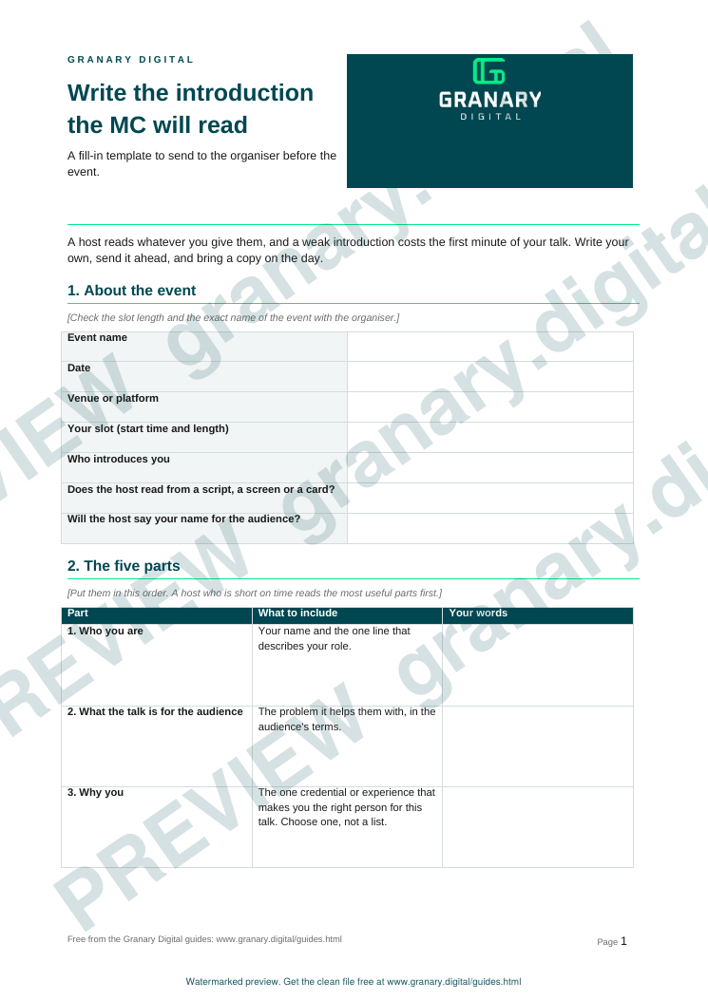
A host reads whatever you give them, and a weak introduction costs the first minute of your talk. Write your own, send it ahead, and bring a copy on the day. The template below gives you the five parts to fill in. Put them in the order shown, so a host who is short on time still reads the most useful parts.
Before you write
Check the length of the slot and the name of the event, and find out how the host will introduce you. Ask whether they read from a script, a screen or a card, and whether they will pronounce your name for the audience. Write the introduction for the room you are speaking in, not for a general audience.
Get the template
The preview is free to look at and print. For the clean file, without the watermark, put your email in and we will send a download link straight away. You also join From the Barn, our monthly studio email, which you can leave whenever you like.
Open the watermarked preview (PDF)
Done. The download link is on its way to your inbox and works for 7 days. If it has not arrived in a few minutes, check your spam folder.
What to include
- Who you are. Your name and the one line that describes your role.
- What the talk is for the audience. The problem it helps them with, in the audience's terms.
- Why you. The one credential or experience that makes you the right person for this talk. Choose one, not a list.
- The title. The exact title of the talk as it appears in the programme.
- How to say your name. A short phonetic version, if the name is hard to say.
A worked example
This example is invented, for illustration only.
"Our next speaker is Sam Patel, who has spent twelve years helping small firms price what they sell. Today's talk is called 'Pricing without the panic'. Sam will show you the three numbers to check before you change a single price. Sam's name is pronounced Sam Pa-tel."
The line about the audience comes before the credential, and the title is exact. The host can read it aloud without stopping to work anything out.
Send it ahead and bring a spare
Send the introduction to the organiser at least a few days before the event, and ask them to confirm they have it. Bring a printed copy, and a spare, because the host will often have lost the first one. Present Yourself's advice is to send it ahead and to bring a spare, and it costs very little.
Common mistakes
- Writing a biography. A host has no time for your whole career. Keep to the one credential that matters.
- Jokes that only work if you are in the room. A host reading a joke with no delivery usually falls flat.
- No pronunciation note. A wrong name on stage is hard to recover from.
- Forgetting to send it. A host who has nothing will improvise, and the first minute is then the host's.
If you are building a speaking practice, our Speaker Visibility package is for speakers who want organisers to find them first. For the stage itself, read mic technique, and for the questions after the talk, Q and A without losing the ending.
Related guides
- Mic technique: handheld, lectern and head mic
- Stay in your light
- Using the whole stage, moving with purpose
- Handling interruptions and the elephant in the room
- Q&A without losing the ending
- All guides and tools
The picture at the top of this page is an illustration, not a photograph of a client or a real job.
Questions we get asked
What should a speaker introduction include?
Who you are, what the talk offers the audience, why you are the right person to give it, the title, and how your name is said. Present Yourself's advice is to write it yourself rather than leave it to the host.
How long should a speaker introduction be?
Short enough for the host to read without rushing. If the host has to cut it on the day, the parts that matter most should come first.
Should I send my introduction in advance?
Yes. Send it to the organiser ahead, and bring a printed copy and a spare.
granary.digital · 01243 884993 · studio@granary.digital · The Old Grainstore, Adsdean, Chichester, West Sussex, PO18 9DN · Prices exclude VAT unless marked inc VAT