

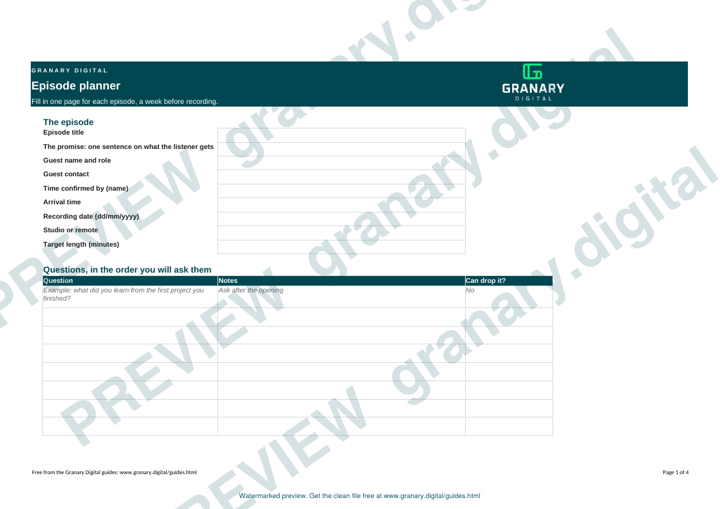
In short: The episode planner holds one episode on one page, from its title and promise to the notes for the editor. The run sheet is the part you use on the recording day: the segments in order, the minutes each one takes and the cues. Fill the planner a week before recording, check that the segments add up to the episode length, and print the run sheet for the room.
The episode planner holds one episode on one page, from the idea to the notes for the edit. The run sheet is the part you use in the room: the order of the segments, the minutes each one takes and the cues. Together they keep a recording on time.
Before you fill it in
Make one copy for each episode. Fill in the planner a week before recording and the run sheet the day before. If the planner takes more than an hour, the episode probably has too much in it.
Get the template
The preview is free to look at and print. For the clean file, without the watermark, put your email in and we will send a download link straight away. You also join From the Barn, our monthly studio email, which you can leave whenever you like.
Open the watermarked preview (PDF)
Done. The download link is on its way to your inbox and works for 7 days. If it has not arrived in a few minutes, check your spam folder.
How to fill it in
- Title and promise. Write the episode title and one sentence that says what the listener will get. If you cannot write the sentence, the episode is not ready to record.
- Guest and contact. Name, role, the person who confirmed the time and the time they should arrive.
- Segments and minutes. Split the episode into named segments, each with a time. Include a cold open, which is the first hook, and a close. Add the minutes up. A 40-minute episode with 50 minutes of segments will overrun in the room.
- Questions. Write the questions in the order you will ask them. Mark any you can drop if the guest is short on time.
- Tech checks. Add lines for the level check, a 30-second room tone recording with nobody speaking, the test take and the start and end of the recording. Note who is in the room and who is joining remotely.
- Notes for the edit. Mark the moments to keep, any takes to avoid and the points where music or a sound effect should go.
A worked example
A 40-minute interview episode, with the run sheet printed for the room:
| Time | Segment | Minutes | Notes |
|---|---|---|---|
| 0:00 | Cold open | 1 | Best line from the interview, read by the host |
| 0:01 | Intro | 2 | Name, show, guest |
| 0:03 | Question block one | 12 | Background and the story behind the work |
| 0:15 | Question block two | 15 | The main idea and the evidence for it |
| 0:30 | Question block three | 7 | Practical advice, with one question that can be dropped |
| 0:37 | Close | 3 | Where to find the guest, and the next episode |
The segments add up to 40 minutes. If the guest runs long, the host drops the optional question in block three rather than cutting the close, so the listener still hears the sign-off.
Common mistakes
- Timing only the talking. Leave time for the set-up, the level check and the wind-down.
- Planning more segments than the episode can hold. Cut one now.
- No cold open. The first minute becomes housekeeping rather than a reason to stay.
- No room tone. Without thirty seconds of silence at the start, the editor has nothing to match the background noise against.
- Writing questions without the guest's background. Read their recent work first, and make one question about it.
If you are booking the Podcast Studio, send a completed run sheet with the enquiry, so we can see the length and the setups you need. The guest booking email and prep sheet is the next document to fill in, and choosing a format comes before both.
Related guides
- Start a podcast: the honest first 90 days
- Podcast format chooser: interview, panel, solo or narrative
- Name, artwork and trailer checklist for a new podcast
- Guest booking email and prep sheet
- All guides and tools
The picture at the top of this page is an illustration, not a photograph of a client or a real job.
Questions we get asked
What should a podcast run sheet include?
The segments in order, the minutes for each, the questions or cues, the tech checks and the start and end of the take. Add notes for the editor so the timings and good moments are easy to find.
How long should a podcast episode be planned for?
Plan the segments to the length you want to publish, and leave a little slack for the set-up and the close. If the segments add up to more than the episode, cut a segment now, not in the room.
Is a run sheet only for video podcasts?
No. Audio podcasts benefit just as much, because the run sheet keeps the recording on time and tells the editor what each part was for.
granary.digital · 01243 884993 · studio@granary.digital · The Old Grainstore, Adsdean, Chichester, West Sussex, PO18 9DN · Prices exclude VAT unless marked inc VAT