

In short: Say your name and who you help in the first ten seconds. Then give one or two facts that earn the next minute, tell one short true story, and link it to the room. Write it down, read it aloud with a timer, and cut the credentials first when it runs long.
A 60-second introduction tells the room who you are, what you do for the people listening and why they should pay attention for the next minute. Most first attempts fail in one of two ways: the speaker runs out of time on their CV, or they never say what they actually do. The fix is structure. Write four short beats, read them aloud with a timer, and cut until the whole thing fits.
What the minute is for
The introduction is not your biography. It sets up everything you say next, so the room knows why you are the one holding the microphone. The one-minute presenting series Present Yourself, by Alastair Greener, makes the same point about the elevator pitch: a 60-second intro needs your name and how you help, your relevant experience and a brief anecdote. The template below turns those three parts into a sequence you can time.
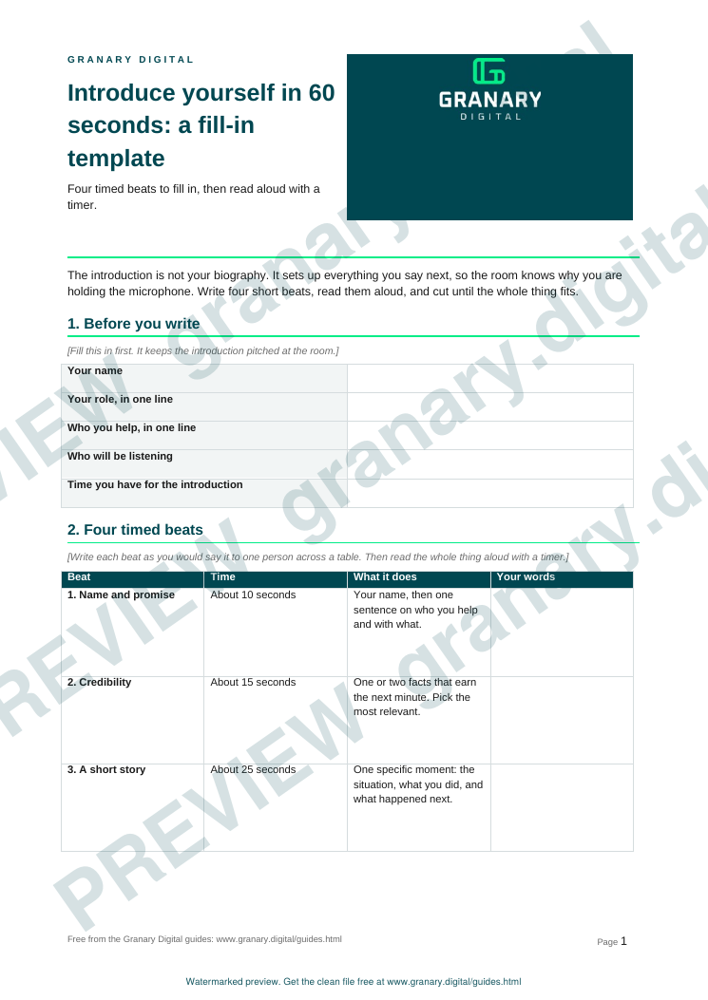
Get the template
The preview is free to look at and print. For the clean file, without the watermark, put your email in and we will send a download link straight away. You also join From the Barn, our monthly studio email, which you can leave whenever you like.
Open the watermarked preview (PDF)
Done. The download link is on its way to your inbox and works for 7 days. If it has not arrived in a few minutes, check your spam folder.
Write it in four beats
- Name and promise (about 10 seconds). Your name, then one sentence on who you help and with what. "I help small accountancy firms explain their work on camera" does more than "I am a consultant".
- Credibility (about 15 seconds). One or two facts that earn the next minute. Pick the most relevant. A list of past employers is the quickest way to lose the room.
- A short story (about 25 seconds). One specific moment that shows how you work. Name the situation, what you did and what happened next. Keep it to one event.
- Link to the room (about 10 seconds). One sentence that connects your story to what the audience cares about today. Then stop.
A worked example
Here is a fictional presenter, Priya, who runs a bookkeeping practice in Winchester and has been asked to speak at a local business breakfast.
Hi, I am Priya Mehta. I help sole traders understand their numbers before the tax return forces the issue. I have been doing that for fourteen years, mostly in kitchens and car parks, because that is where my clients work. Last spring a plumber rang me in a panic about a bill he had not seen coming. We sat down with his bank statements and found he had been paying for a van he had sold. Ten minutes later he had a plan. That is the kind of conversation I want you to have this morning.
Read aloud at an easy pace, with a pause after the story, it takes about 45 seconds, which leaves room to breathe. If yours runs long, cut the credentials first.
Common mistakes
- Starting with "So, um, hi everyone" and losing the first ten seconds to apology. Start with your name.
- Listing every job since school. One credential that matters beats five that do not.
- Writing it to be read. Write it as you would say it to one person across a table, then read it aloud and fix any sentence you trip over.
- Rehearsing only in your head. Timing matters, and you only hear the problems out loud.
- Relying on a joke. A short true story does the same job with less risk.
Say it before the room hears it
Say the introduction at least three times before a shoot or an event: once standing up, once with your phone recording, and once to someone who does not know your work. The last version tells you whether a stranger will understand it. Our what to bring list covers the rest of the kit to pack before a camera day.
If you are preparing for camera, what to wear on camera covers how to look on screen.
The picture at the top of this page is an illustration, not a photograph of a client or a real job.
Questions we get asked
How do I introduce myself in 60 seconds?
Say your name and who you help in the first ten seconds, then one or two relevant facts, a short true story and a sentence that links to the room. Read it aloud with a timer and cut until it fits.
What should I leave out of a short introduction?
Long lists of past employers, apologies for being there and any joke that needs a laugh to work. One credential that matters does more than five that do not.
Should I write my introduction word for word?
Write it in full so you can time it, then speak from a few cue words. Rehearse until the words sound like you, because a read-out introduction is easy to hear.
granary.digital · 01243 884993 · studio@granary.digital · The Old Grainstore, Adsdean, Chichester, West Sussex, PO18 9DN · Prices exclude VAT unless marked inc VAT