

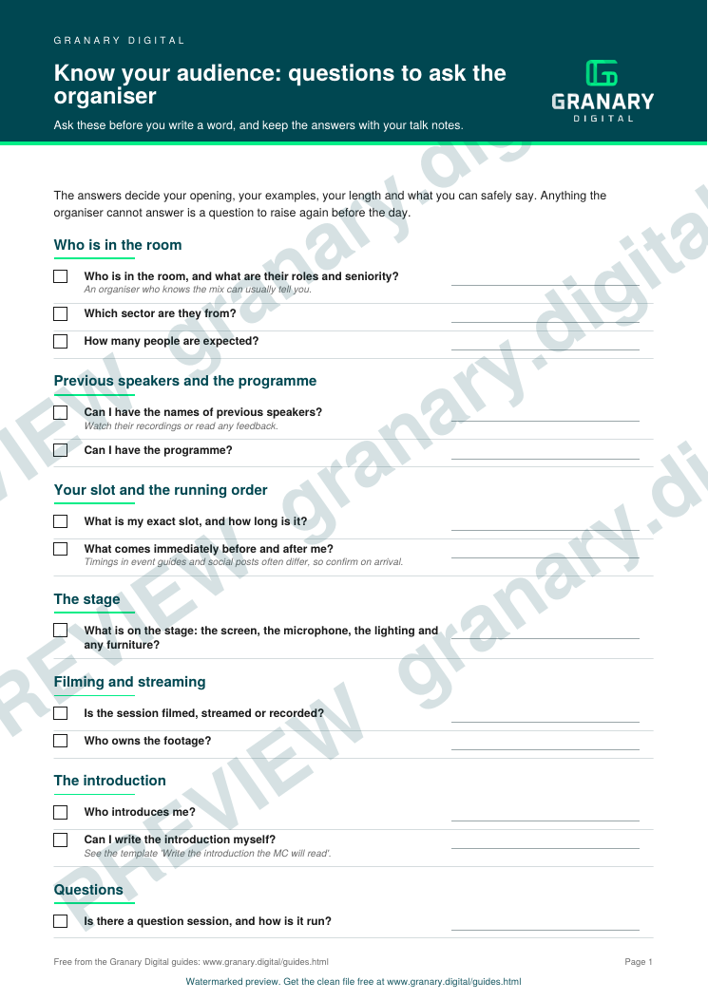
In short: Ask the organiser these questions before you write a word. The answers decide your opening, your examples, your length and what you can safely say. Work through the checklist, write down the answers, and keep them with your talk notes. Anything the organiser cannot answer is a question to raise again before the day.
A talk pitched at the wrong room, the wrong length or the wrong level will struggle however well it is delivered. Ask first, then write.
What the checklist is for
The checklist gathers the questions that shape a talk: who is in the room, how long you have, what the stage and the screen look like, and whether anything is being recorded. Send it to the organiser as soon as you have the booking, and file the answers with your notes.
Get the checklist
The preview is free to look at and print. For the clean file, without the watermark, put your email in and we will send a download link straight away. You also join From the Barn, our monthly studio email, which you can leave whenever you like.
Open the watermarked preview (PDF)
Done. The download link is on its way to your inbox and works for 7 days. If it has not arrived in a few minutes, check your spam folder.
Who uses it
Speakers preparing for a conference, an internal event or a panel. Agents and managers who brief speakers for a client. Anyone asked to speak at short notice who needs to know what they are walking into.
How to use it, step by step
- Ask who is in the room. Find out their roles, seniority and sector. An organiser who knows the mix can usually tell you.
- Ask for the names of previous speakers. Watch their recordings or read any feedback, and refer to earlier talks where it helps.
- Ask for the running order, your exact slot, and what happens immediately before and after you. Timings in event guides and social posts often differ, so confirm on arrival.
- Ask what is on the stage: the screen, the microphone, the lighting and any stage furniture.
- Ask whether the session is being filmed, streamed or recorded, and who owns the footage.
- Ask who introduces you, and whether you can write the introduction yourself. Write the introduction the MC will read covers how.
- Ask whether there is a question session, and how it is run.
A worked example
Here is an invented example. A speaker is booked to talk about cutting costs at a manufacturer's annual event. The answers show a room of mostly line managers, with two senior directors on the front row, a fifteen-minute slot after lunch, and a live stream. The speaker rewrites the opening around the shop-floor problem, drops the financial jargon, checks the slides for readability on the stream, and moves the questions to the last few minutes. The talk keeps its length, and now it fits the room.
Common mistakes
- Accepting the first answer without checking the timings. Confirm them on the day.
- Asking only about audience size. Seniority and sector change the talk more.
- Not asking who introduces you. A poor introduction costs the first minute.
- Assuming the session is not recorded. Ask, and ask who owns the footage.
For the next questions to work through, see inclusive and neurodiverse-friendly presenting and presenting to Gen Z. If you speak often and want organisers to find you, the Granary Speaker Visibility package is built for that.
Related guides
- Inclusive and neurodiverse-friendly presenting
- Presenting to Gen Z (and every other generation)
- All guides and tools
The picture at the top of this page is an illustration, not a photograph of a client or a real job.
Questions we get asked
What should I ask an event organiser before a talk?
Ask who is in the room, the length and timing of your slot, what is on stage, whether the session is filmed or streamed, who owns the footage, and who introduces you.
Why does audience seniority matter for a talk?
Seniority and sector change which examples land and how much detail the room wants. A talk for line managers and a talk for directors can cover the same point in very different ways.
Can I ask the organiser for the programme and the previous speakers?
Yes, and you should. The running order shows what comes before and after you, and earlier speakers show the tone the organiser expects.
granary.digital · 01243 884993 · studio@granary.digital · The Old Grainstore, Adsdean, Chichester, West Sussex, PO18 9DN · Prices exclude VAT unless marked inc VAT