

In short: Before you book a location, confirm who owns it and get their written permission. Then check access, parking, power, light direction, sound and safety. Visit at the time of day you plan to shoot, take photographs and measurements, and write a plan B. A site can look right and still fail on access, power or noise.
A recce answers one question: can we shoot what the shot list says, here, on the day? Walk the site with the list in hand, and answer each line on the checklist. Anything you cannot answer is a question to send to the owner before you commit.
Permission first
Find out who owns the land or building, and who controls filming on it. Public land can need a permit from the council or highway authority, and private land needs the owner's written consent. A location agreement sets out the dates, the areas, the fees, the insurance and what happens if the shoot is cancelled. The location release guide explains what to fill in, and the filming permission guide covers who to ask around Chichester.
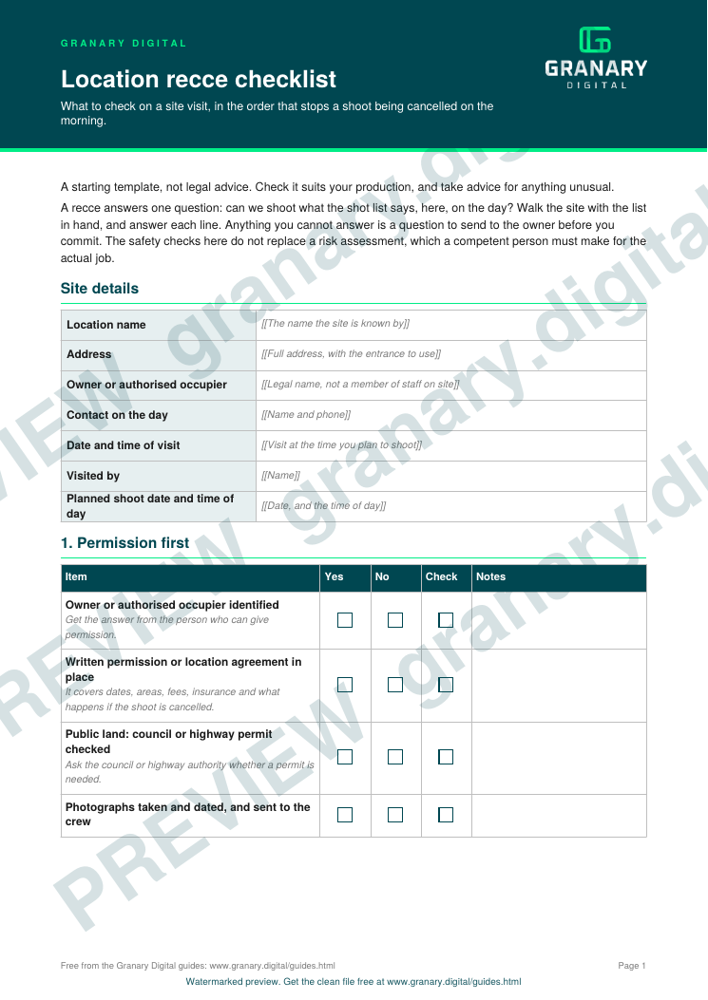
Get the checklist
The preview is free to look at and print. For the clean file, without the watermark, put your email in and we will send a download link straight away. You also join From the Barn, our monthly studio email, which you can leave whenever you like.
Open the watermarked preview (PDF)
Done. The download link is on its way to your inbox and works for 7 days. If it has not arrived in a few minutes, check your spam folder.
Access and parking
- Can the van reach the location, and how close can it stop?
- How far is the walk from the van to the set, with cases?
- Is there parking for the crew and the talent, and is it free?
- Are there any height, width or weight limits on the route in?
Power and light
- Where is the nearest power supply, and does it run the kit you plan to use? Ask the owner to show the supply, and do not guess from a socket on the wall.
- Note which way the light comes from, and when the sun is in the shot. The sun path planner helps with the direction.
- Check for reflections, shade and any light that will change during the day.
Sound
- Visit at the time of day you plan to shoot, and listen for traffic, aircraft, machinery, pumps, birds, dogs and church bells.
- Note any hard surfaces that will echo.
- Find out whether any noise is controlled on the day, such as a works project or a road closure.
Safety
This is general guidance. A competent person must assess the actual site and the hazards on the job.
- Note any uneven ground, steps, water, slopes or overhead cables.
- Find the nearest toilet, first aid point and a place to get in out of the rain.
- Identify the route to hospital, and the nearest phone signal for the call sheet.
Worked example
A recce for an interview in a farm barn shows a good view and a good window of light. At the visit the tractor work next door is the only sound on the day, and the owner confirms it runs from nine until noon. The interview moves to the afternoon, the agreement notes the working hours, and the call sheet lists the nearest hospital.
Common mistakes
- Checking for the view only. A site can look right and still fail on access, power or noise.
- Visiting at the wrong time. A quiet Sunday morning tells you nothing about a Tuesday school run.
- Trusting a verbal yes. Get the permission in writing, from the person who can give it.
- No photographs or measurements. Take them, date them and send them to the crew.
- No plan B. Write down an indoor or a second location before you need one. The studio or location guide sets out when a stage is the better answer.
Sources
- Sprintlaw, Legal checklist for filming in the UK, read 5 November 2026
- Filming in England, guide for property owners on location agreements (understanding LA 1 1), read 5 November 2026
Related guides
The picture at the top of this page is an illustration, not a photograph of a client or a real job.
Questions we get asked
What is a location recce?
A recce is a site visit before the shoot, to check the location against the shot list. You look at permission, access, power, light, sound and safety, and you record the answers so the crew can plan from them.
When should I visit a location?
At the same time of day, and ideally on the same day of the week, as the shoot. Traffic, school runs and the sun change the picture and the sound.
Who needs to sign off a location?
The owner or the authorised occupier, not a member of staff who happens to be on site. Sprintlaw and Filming in England both advise a written agreement for a shoot with crew and equipment.
granary.digital · 01243 884993 · studio@granary.digital · The Old Grainstore, Adsdean, Chichester, West Sussex, PO18 9DN · Prices exclude VAT unless marked inc VAT