

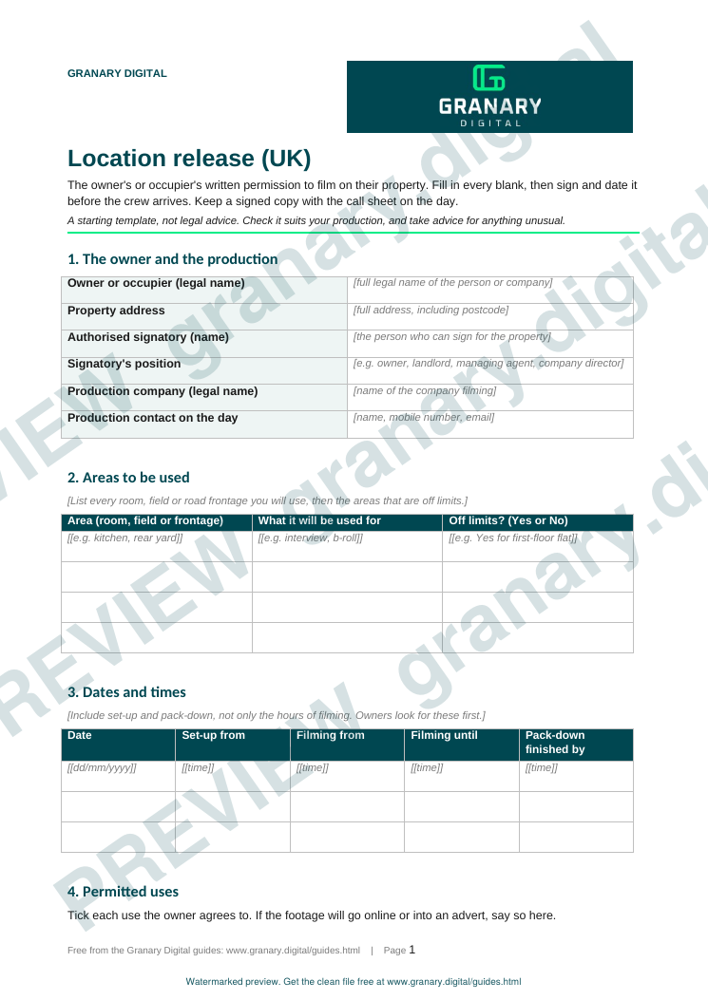
In short: A location release is the owner's or occupier's written permission to film on their property. Fill in the owner, the exact areas, the dates and times including set-up and pack-down, the permitted uses, the fee, the insurance, the cancellation terms and a signature from the person who can sign. Get legal advice before using the form for a large or risky shoot.
A location release is the permission that makes a shoot legitimate on someone else's ground. It is written, it names the place and the dates, and it is signed by the person who controls the property. The template below gives you the parts to fill in. It is a starting point, not legal advice, and a large or risky shoot should have a solicitor look at the final version.
What the template covers
Owners who read a location agreement look for the same things. The Filming in England guide for property owners lists the areas that can be used, the dates and times including set-up and pack-down, the fees and any overtime, whether temporary changes are allowed and how the site is put back, the permitted uses, limits on noise or stunts, confidentiality and publicity, and how either side can cancel.
Get the template
The preview is free to look at and print. For the clean file, without the watermark, put your email in and we will send a download link straight away. You also join From the Barn, our monthly studio email, which you can leave whenever you like.
Open the watermarked preview (PDF)
Done. The download link is on its way to your inbox and works for 7 days. If it has not arrived in a few minutes, check your spam folder.
Filling it in, step by step
- Name the owner or occupier. Use the legal name of the person or company, and the address of the property. A name on a sign is not enough.
- Describe the areas. List the rooms, fields or road frontages you will use, and any areas that are off limits.
- Write the dates and times. Include the set-up and pack-down, not only the hours of filming.
- State the uses. Say whether it is for a film, an advert, a training video or a photo shoot, and whether you will use the footage online.
- Agree the fee. Write the fee, any overtime rate and what happens if the shoot runs over.
- Confirm the insurance. Say what cover you hold, and what the owner can ask to see.
- Set out the cancellation terms. Write the notice period each side must give.
- Sign and date. Keep a signed copy with the call sheet on the day.
Worked example
A small production wants to film a two-hour interview in a barn on a farm. The release names the owner and the barn, marks the yard as off limits, and sets the day for Thursday 12 November 2026, from 8am for set-up until 3pm for pack-down. The fee is agreed in writing, the cancellation notice is 14 days, and the owner signs the document before the crew arrives.
Common mistakes
- Signing with a staff member. A worker on site may not have the authority to say yes. Check with the owner or the landlord.
- Leaving out the pack-down. Kit and rubbish left in the yard after the shoot can cause more trouble than the filming.
- Forgetting the footage use. If the film will go online or into an advert, say so in the uses.
- Skipping the insurance line. Owners often ask for it before they sign.
- Treating the template as the end of the job. Check any local permit rules as well, and see the location recce checklist for what else to confirm.
For people who appear on camera, the releases guide covers talent, property and minors, and for a studio the when a studio beats a location guide compares the two options.
Sources
- Sprintlaw, Legal checklist for filming in the UK, read 5 November 2026
- Filming in England, guide for property owners on location agreements (understanding LA 1 1), read 5 November 2026
Related guides
The picture at the top of this page is an illustration, not a photograph of a client or a real job.
Questions we get asked
Do I need a written location release in the UK?
For a commercial shoot with crew and equipment, a written agreement is usually better than an email, and some owners will not accept less. Sprintlaw says an email may do for a low-risk shoot, and that a formal agreement is better for commercial filming, shoots with crew and equipment, and shoots that may disrupt operations.
Who signs a location release?
The owner, landlord or authorised occupier. A member of staff on site may not have the authority to approve filming, so check with the head office or the landlord before the day.
Is a location release the same as a model release?
No. A location release covers the place. A model or talent release covers the people in front of the camera, and the [consent and GDPR guide](filming-people-uk-gdpr-consent-and-when-you-need.html) explains when each applies.
granary.digital · 01243 884993 · studio@granary.digital · The Old Grainstore, Adsdean, Chichester, West Sussex, PO18 9DN · Prices exclude VAT unless marked inc VAT