

In short: A prop and set dressing list records every object that can be seen on camera, the set it sits in, its source (hire, buy or build), its owner and what happens to it at the end. Build it from the script before the recce, give each line a number that matches the shot list, and keep one master copy. Update it the same day anything changes.
Anything an actor touches, and anything the camera can see, goes on the list. The sheet lets the props team rebuy a broken mug, lets the set dresser reset a room between takes, and lets someone return hired kit on time. Without it, the arguments happen on the morning of the shoot.
What the list is for
A prop and set dressing list does three jobs. It tells the buyer what to find, it tells the set dresser what goes where, and it tells the continuity team what has to look the same from one take to the next. The same sheet becomes the return list for hired items and the cost check when purchases are added up.
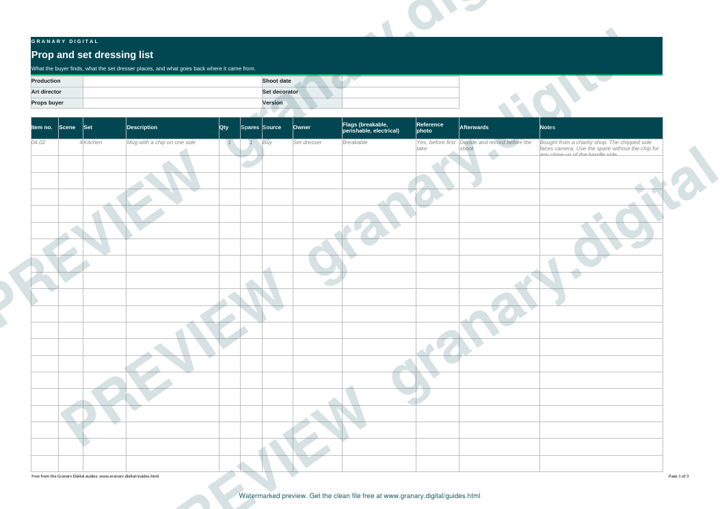
Get the template
The preview is free to look at and print. For the clean file, without the watermark, put your email in and we will send a download link straight away. You also join From the Barn, our monthly studio email, which you can leave whenever you like.
Open the watermarked preview (PDF)
Done. The download link is on its way to your inbox and works for 7 days. If it has not arrived in a few minutes, check your spam folder.
How to fill it in
- Read the script for every object a character handles, eats from, drinks from, reads or looks at. Note the scene number beside each one.
- Walk the room with the camera framing in mind and add the background dressing: pictures, books, rugs, plants and curtains. These give a set its look, and they are the lines most often left out.
- Give every line its own number, such as 04.01. Use the same number on labels, reference photographs and the shot list.
- Describe each item in words a buyer can search for: size, colour, material, period and any make the script names. Add a reference photograph where you have one.
- Record the quantity. Anything that breaks, gets stained or appears in a close-up needs at least one spare.
- Mark the source as hire, buy or build. A built item also needs a line on the construction list.
- Name one owner for every line. "The art department" is a team, not an owner.
- Note what happens at the end: returned to the hire house, sent back to the client, kept by a cast member or thrown away.
Worked example
A kitchen scene, scene 4, shot in one day.
- 04.01, electric kettle, cream, period style. Two needed, one for the close-up and one spare. Source: hire. Owner: props buyer. At the end: back to the hire house after testing.
- 04.02, mug with a chip on one side. One needed, plus a spare without the chip. Source: bought from a charity shop. Owner: set dresser. Note: the chipped side faces camera. Photograph it before the first take.
- 04.03, two loaves of bread. Perishable. Source: bought the day before. Owner: props buyer. At the end: thrown away after the shot.
Each line answers the same questions, so nobody has to ask on the day what to do with the bread.
Common mistakes
- Listing only what the script names. Background dressing gives a room its look, and it is where a set usually goes wrong.
- No spares. A breakable prop with no spare costs a take at best and a shot at worst.
- No photographs. A photo of each set as it was left is the cheapest continuity record you can make.
- Changing things on the day without updating the sheet. Then the return list and the bill are both wrong.
- Using the sheet as a shopping list alone. It also has to show owners and what happens at the end.
Electrical items need a competent person to check them before they go in front of a camera. Ask the hire house for proof of testing, and treat anything without it as untested. This is general guidance, and a competent person must assess the actual kit.
For the wider picture, what you may build in the barn is the place to check before you plan a built set, and flats, plinths and risers covers the carpentry that goes into one. The roles behind the sheet are described in what a prop master does and what a set decorator does. For a set built where it will be shot, see set building.
Related guides
Questions we get asked
What should a prop list include?
For each item, record a number, a short description, the scene and set, the quantity, the source (hire, buy or build), an owner and what happens to it afterwards. Add a note if the item is breakable, perishable or electrical.
Who fills in the set dressing list?
The art department usually owns it. The production designer or art director sets the look, the set decorator fills the rooms, and the props buyer or props master sources and tracks the items. On a small shoot one person often does all of these jobs.
When should the prop list be finished?
Start it as soon as the scenes being shot are fixed, and finish a first version before the recce. Late additions are normal, but each one should go on the list the same day.
granary.digital · 01243 884993 · studio@granary.digital · The Old Grainstore, Adsdean, Chichester, West Sussex, PO18 9DN · Prices exclude VAT unless marked inc VAT