

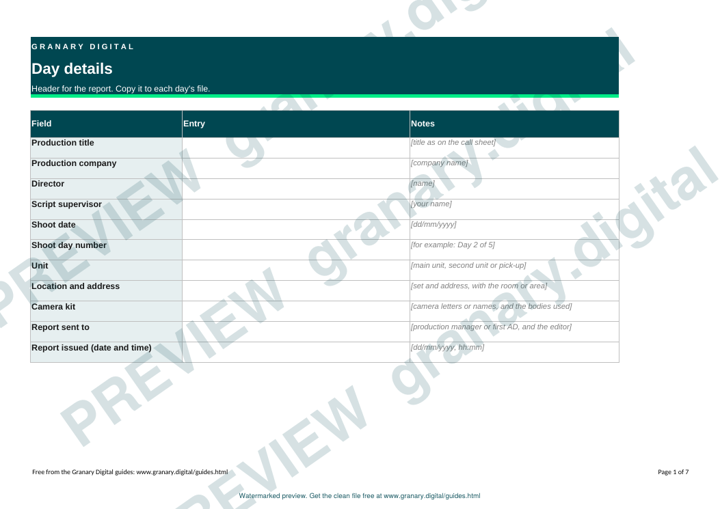
In short: The script supervisor's daily report records each scene shot, its status, the takes and the circled takes, the camera and lens details, the cast on set and any continuity notes. It goes to production at the end of each shoot day. Fill it in during the day, while the details are fresh, rather than from memory at wrap.
The daily report is the script supervisor's record of the day, and it is also how production learns what was shot and what still has to be shot. Every line has to be accurate, because the producer and the editor will rely on it. Fill it in as the day goes, while the details are still clear.
Get the template
The preview is free to look at and print. For the clean file, without the watermark, put your email in and we will send a download link straight away. You also join From the Barn, our monthly studio email, which you can leave whenever you like.
Open the watermarked preview (PDF)
Done. The download link is on its way to your inbox and works for 7 days. If it has not arrived in a few minutes, check your spam folder.
What goes on the report
Most daily reports share the same core fields. Use them even on a small shoot, because the same questions come up whatever the size of the job.
- Header: production title, date, shoot day number, unit and location.
- Scene record: scene number, a short description, whether the scene is complete, incomplete or not shot, and the reason if it is not complete.
- Takes: the number of takes for each shot and which take is circled as the best.
- Pages and timings: the script pages shot that day and, where the production tracks it, the running time of the material.
- Camera and sound: roll or card numbers and the lens used, so the editor can find the right material.
- Cast: who was on set, and the times they were called and wrapped.
- Continuity notes: any change to dialogue, action, props, costume, eye-lines or position, with the take on which it happened.
- Visual effects and stunts: any shot that needs a VFX note, or a stunt that the VFX or stunt team must know about.
The circled take is the one the director and script supervisor agree is the best, and the report must say why when it is not the last take.
How to fill it in during the day
- Log each scene as it starts, not at lunch. A scene that started and stopped is still a scene to record.
- After each take, write the take number, the outcome and any change to the script. Do this before the next setup.
- Check the roll or card number against the camera report at the end of each setup.
- Note any line that was changed or dropped, with the take it happened on.
- At wrap, check every scene on the schedule has a status, then send the report to production the same day.
Worked example
Scene 12 is a conversation at a kitchen table.
- Shot 12A, takes 1 to 4. Take 2 has a dropped line. Take 3 is circled because the performance is right and the eye-line holds.
- Note on take 3: the cup is on the left, not the right. Continuity photograph taken before take 4.
- Shot 12B, take 1 is circled. The lens is the one shown on the camera report, and the card number is recorded.
- Status: complete. Cast on set from 09:00 to 13:30.
The editor can start from take 3 for 12A and know why the cup matters.
Common mistakes
- Circling a take without writing the reason, so the next person changes it.
- Marking a scene complete when a shot is missing.
- Forgetting the card or roll numbers, which makes the footage hard to find.
- Leaving out the changed lines, which the editor then has to find by ear.
- Sending the report late, so the next day starts from the wrong scene list.
For the wider role, see what a script supervisor does. A continuity log is a useful companion to this report, and the continuity log template covers the shot by shot record.
Related guides
Questions we get asked
What does a script supervisor's daily report include?
Scenes and shots with their status, takes and circled takes, camera and lens details, the cast and their on-set times, the pages shot, and continuity notes for the editor and the VFX team.
Who receives the script supervisor's daily report?
Production, usually the production manager or first assistant director, and the editor for the film or programme. Visual effects and the director may also need the notes on their scenes.
Why does a daily report matter on a small shoot?
It records which takes were good and what was changed. On a one-day shoot it may be the only thing that tells the editor which take to start with.
granary.digital · 01243 884993 · studio@granary.digital · The Old Grainstore, Adsdean, Chichester, West Sussex, PO18 9DN · Prices exclude VAT unless marked inc VAT