

In short: For each episode, fill in a title, a two-sentence summary, notes with links and credits, chapter timestamps in the order they occur, and a transcript with speaker names. Write the summary after the transcript, check every timestamp against the finished audio, and clean the transcript without changing what was said.
Every episode needs written material, even if few people read it. Show notes give a listener the summary and the links, chapters let them skip to what they want, and a transcript gives them, and search engines, text to work with. This template keeps all three in one place, so they are written once and checked once.
Fill it in, step by step
- Title and episode number. Use the episode title as you would say it, with the guest's name where it helps someone find the episode.
- Transcript. Start here. Name the speakers at each change, remove filler words where the meaning does not change, and leave opinions exactly as they were said.
- Summary. Two sentences, written from the transcript. Say who is speaking and what they cover.
- Notes. Links to anything mentioned, each with a short reason. Include a guest's own links only if the guest has agreed to them going out.
- Chapters. One line per chapter: a timestamp, then a short title. Start at 00:00:00 with the intro.
- Credits and disclosures. Who made the episode, and any sponsor named clearly and in the same words the sponsor uses.
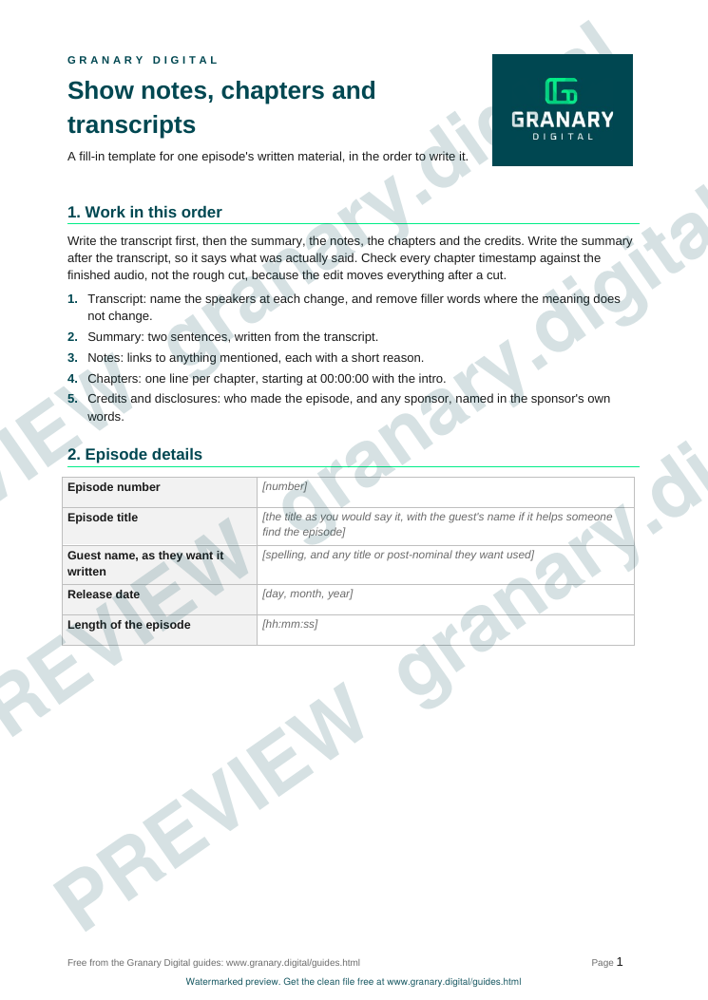
Get the template
The preview is free to look at and print. For the clean file, without the watermark, put your email in and we will send a download link straight away. You also join From the Barn, our monthly studio email, which you can leave whenever you like.
Open the watermarked preview (PDF)
Done. The download link is on its way to your inbox and works for 7 days. If it has not arrived in a few minutes, check your spam folder.
A worked example
A fictional show about small boatyards publishes episode 14, with a guest who restores wooden boats. The written material reads like this.
- Title: Restoring a clinker hull, with Dan Ashby
- Summary: Dan Ashby talks through a season of restoring a clinker dinghy. The conversation covers planking, why he still uses hand tools, and what he would tell a first-time restorer.
- Notes: Links to the boatbuilding book Dan mentions, and to the local museum where he learned the trade, each with a line on why it came up.
- Chapters: 00:00:00 Intro · 00:02:10 Why clinker · 00:14:40 Replacing a plank · 00:38:05 Advice for beginners
- Transcript, first turn: Host: Why clinker? Dan: Because it is light, and you can see every plank you have fitted.
Common mistakes
- Timestamps copied from a rough cut. Check every one against the finished audio, because the edit moves everything after a cut.
- A transcript that tidies a speaker into someone they were not. Remove filler words, not meaning.
- Notes that list links with no reason to follow them.
- Unnamed speakers, so the reader cannot tell who said what.
- Chapters that last a few seconds. A very short chapter is usually a sentence that belongs in the chapter before it.
Where the publishing fits
The written material is the last thing a listener sees, so it is worth writing it as the episode is locked rather than weeks later. Granary's publishing add-on is £195 +VAT per episode and is added to any recording booking. It runs from the locked edit and transcript. The episode planner and run sheet helps you plan the episode so the notes are easy to write afterwards, and one podcast episode a month of clips shows how the same material turns into short clips.
The picture at the top of this page is an illustration, not a photograph of a client or a real job.
Questions we get asked
What should podcast show notes include?
A two-sentence summary, links to anything mentioned with a short reason for each, and the guest's name written the way they want it. Keep it to what a listener would use.
How do I write podcast chapter timestamps?
Use hours, minutes and seconds, start at 00:00:00, and check each timestamp against the finished audio rather than the rough cut. Write one line per chapter with a short, specific title.
Do I need a transcript for a podcast?
It helps readers who prefer text and gives search engines words to read. Clean it, check the names, and keep it faithful to what was said.
granary.digital · 01243 884993 · studio@granary.digital · The Old Grainstore, Adsdean, Chichester, West Sussex, PO18 9DN · Prices exclude VAT unless marked inc VAT