

In short: Choose the frame shape from the delivery: 16:9 for horizontal video on television and the web, 9:16 for vertical video on phones, and 2.39:1 for a widescreen film look. Draw one panel per shot, put the shot number underneath, mark the camera move with an arrow and write the dialogue or action beside it. Stick figures are enough if the position of each person and the frame are clear.
What the sheets are for
A storyboard lets the director, the director of photography and the client agree on the picture before the lights go up. It shows the frame, the position of the people in it and the move. It does not replace the shot list, which says how long each shot takes and what it needs.
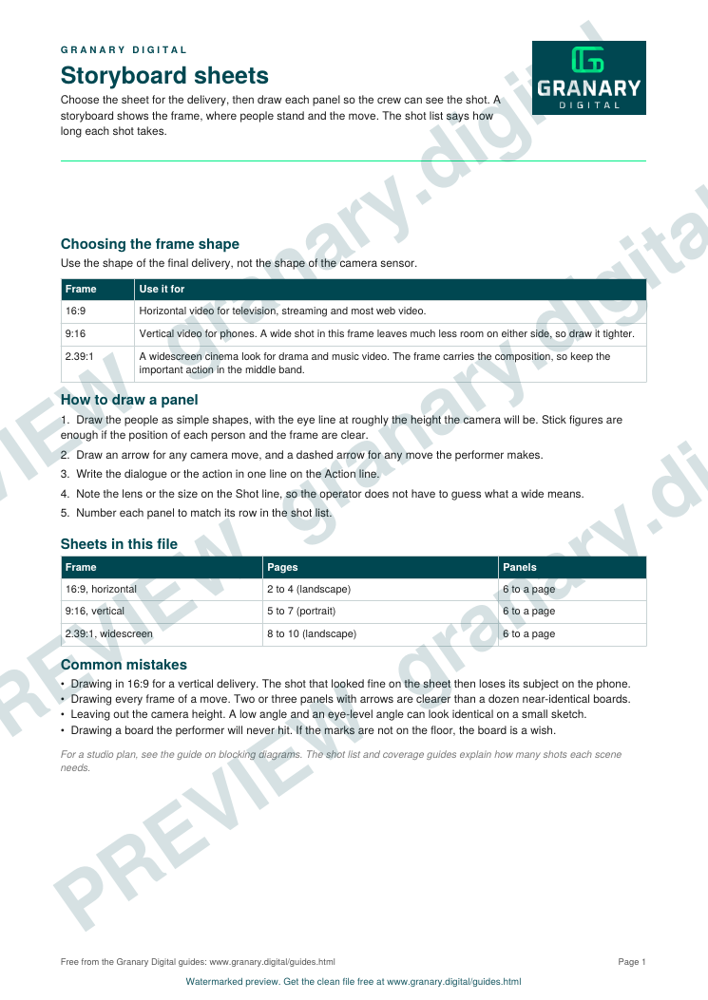
Get the template
The preview is free to look at and print. For the clean file, without the watermark, put your email in and we will send a download link straight away. You also join From the Barn, our monthly studio email, which you can leave whenever you like.
Open the watermarked preview (PDF)
Done. The download link is on its way to your inbox and works for 7 days. If it has not arrived in a few minutes, check your spam folder.
Choosing the frame shape
Use the frame shape of the delivery, not the shape of the camera's sensor.
- 16:9 is the standard horizontal shape for broadcast, streaming and most web video.
- 9:16 is tall. It suits phone-first video, and a wide shot drawn in this frame leaves much less room for the scene on either side.
- 2.39:1 is a wide cinema shape. It suits drama and music video where the frame carries the composition. It is easy to draw too much in, so keep the important action in the middle band.
How to draw a panel
- Draw the frame in the chosen shape. Write the shot number in the top corner.
- Place the people as simple shapes, with the eye line roughly at the height the camera will be.
- Draw an arrow for any camera move, and a dashed arrow for any move the performer makes.
- Write the dialogue or the action in one line under the panel.
- Note the lens or size in the margin, so the operator does not have to guess what a wide means.
A worked example
A three-panel sequence for a product reveal in a 9:16 frame:
- Panel 1 (wide, 35 mm): the bottle sits on the plinth, the frame is mostly empty. Arrow shows a slow push in.
- Panel 2 (close-up): the hand enters from the right. Note: "hand from right, not from camera".
- Panel 3 (mid): the bottle is lifted and turned to camera. Note the rotation.
The three panels tell the crew where the bottle sits, where the hand comes from and when the move starts, which is what the crew needs on the day.
Common mistakes
- Drawing in 16:9 for a vertical delivery. The shot that looked fine on the sheet then loses its subject on the phone.
- Drawing every frame of a move. Two or three panels with arrows are clearer than twelve near-identical boards.
- Leaving out the camera height. A low angle and an eye-level angle can look identical on a small sketch.
- Drawing a board the performer will never hit. If the marks are not on the floor, the board is a wish.
Using the sheets with a shot list
Number each panel to match its row in the shot list template, so the crew can move from the drawing to the list without asking. For how the sheets fit into a studio plan, see blocking diagrams for a studio.
Related guides
Questions we get asked
What aspect ratio should a storyboard use?
Use the shape of the final delivery. 16:9 suits most horizontal video, 9:16 suits vertical social video and 2.39:1 gives the widescreen film look.
Do I need to draw well to make a storyboard?
No. Boxes and stick figures work if each panel shows the frame, where people stand and an arrow for any movement.
granary.digital · 01243 884993 · studio@granary.digital · The Old Grainstore, Adsdean, Chichester, West Sussex, PO18 9DN · Prices exclude VAT unless marked inc VAT