

In short: A film treatment is a prose summary of a film, usually a few pages, with a logline, the story in three acts, the main characters and the locations. A reader should finish it knowing what happens and how it ends. Write the logline first, summarise each act, state the ending and cut anything that is not story.
A treatment is the film told in prose, with the logline at the top and the ending included. Producers and funders read it to decide whether the film is worth making, so it needs to say what happens and why it matters.
What the template asks for
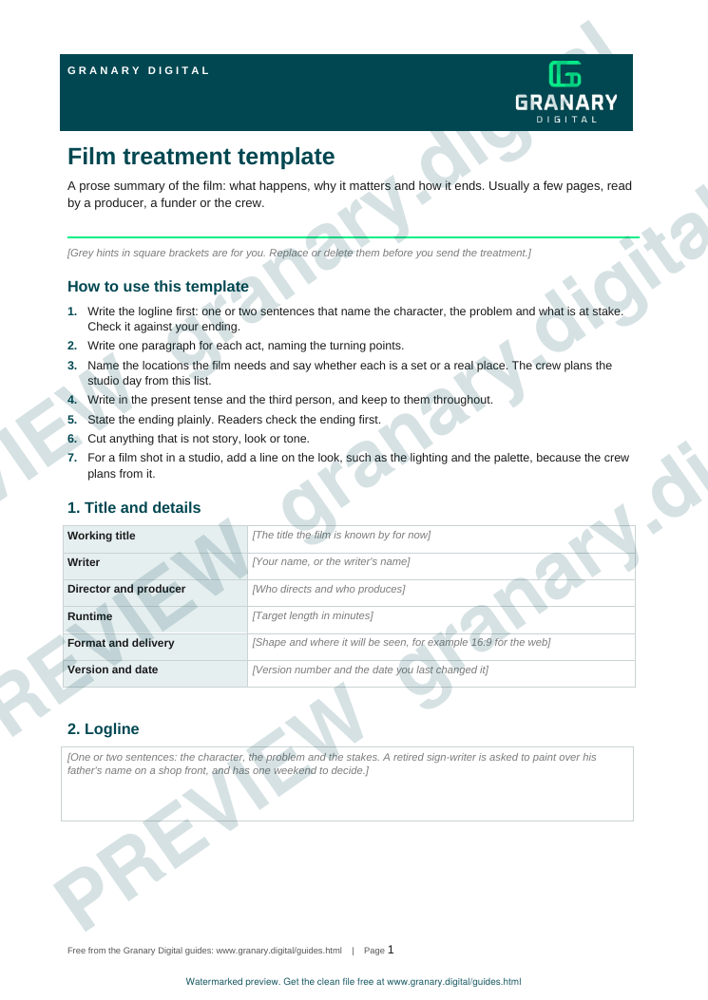
Use the sections below in this order. StudioBinder's guide lists the title, your name, the logline, the concept and theme where the film needs them, a summary of each of the three acts with the plot points, locations and characters, and any background the reader needs.
Get the template
The preview is free to look at and print. For the clean file, without the watermark, put your email in and we will send a download link straight away. You also join From the Barn, our monthly studio email, which you can leave whenever you like.
Open the watermarked preview (PDF)
Done. The download link is on its way to your inbox and works for 7 days. If it has not arrived in a few minutes, check your spam folder.
How to write it, step by step
- Write the logline first: one or two sentences that name the character, the problem and what is at stake. Check it against your ending before you go on.
- Write one paragraph for each act, naming the turning points.
- Name the locations the film needs and say whether each is a set or a real place. The crew plans a studio day from this list.
- Write in the present tense and the third person, and keep to it throughout.
- State the ending plainly. Many readers turn to the ending first.
- Cut anything that is not story, look or tone.
- For a film shot in a studio, add a line on the look, such as the lighting and the palette, because the crew plans from it.
A worked example
Logline: A retired sign-writer agrees to paint over his father's name on a shop front, then finds he cannot finish the job.
Act one: Harold, a sign-writer in his seventies, is asked by the new owner to remove the name his father painted over the door. He agrees, because the shop is his only real connection to the town.
Act two: Harold visits the shop each morning and strips the old gold leaf one letter at a time. Each letter brings back a memory, and the new owner starts to ask why he is still there.
Act three: On Sunday, Harold paints the new name beside the old one, and the owner agrees to leave the original in place. The last shot holds on the two names together.
Common mistakes
- A logline that states the theme ("a story about loss") rather than the story.
- No ending, which leaves the producer guessing.
- A scene-by-scene list in place of a summary.
- Pages of dialogue. A treatment is prose, so give the essence of a conversation, not every line.
- Padding with credits or backstory the story never uses.
For the next step, the AV script template and the pitch deck structure for short films cover what comes after the treatment, and the script timing calculator estimates how long the finished script will run.
Sources
- StudioBinder, How to write a film treatment, read 5 November 2026
Related guides
Questions we get asked
How long should a film treatment be?
For a reader you do not know, StudioBinder suggests keeping it under ten pages, single spaced. For a production company or studio, ask what they want, because some ask for twenty pages or more.
What is a logline?
A logline is one or two sentences that give the character, the problem and the stakes. It goes at the top of the treatment, above the summary.
Is a treatment the same as a script?
No. A treatment tells the story in prose, without scene formatting or dialogue. A screenplay is written in scene format with dialogue, and an AV script sets out sound and picture in two columns.
granary.digital · 01243 884993 · studio@granary.digital · The Old Grainstore, Adsdean, Chichester, West Sussex, PO18 9DN · Prices exclude VAT unless marked inc VAT