

In short: A release is a signed record of permission. Use a talent release for each person on camera, a location release for a place you do not own, and a property release for an object with an owner. Record what is agreed, where and for how long. For a child, check the licence position with the home local authority before the day.
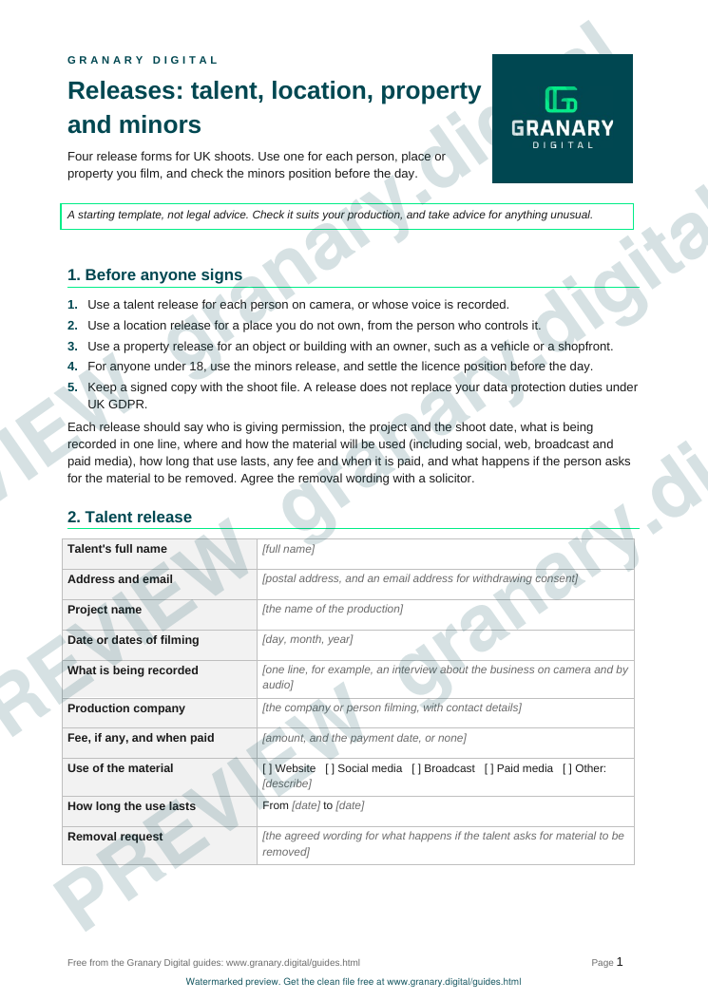
A release is a short agreement that records permission. It protects the person who owns the material and the person who appears in it, so it should say what was agreed in plain words. This page covers the four types, what each should hold, and the checks that sit outside the form.
The four types
- Talent release. For a person who appears on camera or whose voice is recorded.
- Location release. Permission to film at a place, from the person who controls it, with the dates and access agreed.
- Property release. The same for an object or building with an owner, such as a vehicle or a shopfront.
- Minors release. For anyone under 18, with the signatory and the licence check settled before the day.
Get the template
The preview is free to look at and print. For the clean file, without the watermark, put your email in and we will send a download link straight away. You also join From the Barn, our monthly studio email, which you can leave whenever you like.
Open the watermarked preview (PDF)
Done. The download link is on its way to your inbox and works for 7 days. If it has not arrived in a few minutes, check your spam folder.
What each release should hold
- Who is giving permission, with their contact details.
- The project name and the date of the shoot.
- What is being recorded, in one line.
- Where and how the material will be used, including social, web, broadcast and paid media.
- How long that use lasts.
- Any fee, and when it is paid.
- What happens if the person asks for the material to be removed. Agree the wording with a solicitor.
- The signature, the date and the person's name in print.
UK GDPR and consent
A release does not replace your data protection duties. The Information Commissioner's Office says valid consent is freely given, specific, informed, unambiguous and withdrawable, and that you must be able to demonstrate it. Keep a signed copy with the shoot file, and say in the release how someone can withdraw.
Minors and licences
The Department for Education's advice on child performance licensing in England applies to children below the upper limit of compulsory school age, which as a general rule runs to the last Friday in June of the school year in which the child turns 16. It lists live broadcasts, including internet streaming, recorded performances intended for broadcast or public film exhibition, and paid modelling where the payment is more than expenses as activities that may need a licence, and says a licence may be needed even if the child is unpaid. For a child living in Great Britain, the home local authority issues the licence, and the person organising or running the activity applies for it. The advice covers England, so check the position if you film elsewhere. The advice has no statutory force, so confirm the position with the local authority before the day. The working with children page sets out the wider picture.
Location and property
A location or property release protects the access you arranged. Filming in a public place can need its own permission, so check with the council before the day. The filming in public places page covers the usual routes.
A worked example
A brand film shoots a 30-second scene in a café with two members of staff, a customer who speaks to camera, and a shot of the shopfront. The team collects talent releases from the staff and the customer, a location release from the café owner covering the interior and the dates, and a property release for the shopfront sign. The customer is 16, so the team checks the licence position with the local authority before the day. The release alone does not answer whether a licence is needed.
Common mistakes
- Using one release for every use. A social-only release does not cover a broadcast cut or a paid campaign.
- Leaving out the date or the end date of use.
- Filming a child on a paid shoot without checking the licence position.
- Assuming a child paid only expenses never needs a licence. The advice says a licence may be needed even if the child is unpaid, so check with the local authority.
- Assuming the location owner's permission covers the people who work there.
This is general guidance. Have a solicitor check the wording before a large or long-running campaign. For the wider rights picture, see the voice and likeness consent checklist and the music licensing guide.
Sources
- Information Commissioner's Office, What is valid consent?, read 5 November 2026
- GOV.UK, Child performance and activities licensing legislation in England: departmental advice, read 5 November 2026
- GOV.UK, Child employment: performance licences for children, read 5 November 2026
Related guides
- Ofcom's streaming access code: what 80% subtitles, 10% audio description and 5% signing mean for producers
- The less healthy food ad rules, nine months in: what the rulings mean for your next shoot
- Music licensing for brand video in the UK
- Using AI imagery and voice clones in ads: UK rules
- All guides and tools
The picture at the top of this page is an illustration, not a photograph of a client or a real job.
Questions we get asked
Do I need a release to film people in the UK?
Most commercial shoots record one for each person who appears on camera. The Information Commissioner's Office says valid consent must be freely given, specific, informed, unambiguous and withdrawable, and that you must be able to show someone consented.
Does a child need a licence to appear in an advert?
The departmental advice says a licence may be needed when children take part in paid modelling (payment beyond expenses), live broadcasts including internet streaming, and recorded performances intended for broadcast or film exhibition. The advice has no statutory force, so confirm with the child's home local authority.
Who signs a release for a child?
Usually a parent or legal guardian signs for a child, but confirm this before the shoot. Ask the local authority or a solicitor to confirm the right signatory for your project, and whether a licence is needed.
granary.digital · 01243 884993 · studio@granary.digital · The Old Grainstore, Adsdean, Chichester, West Sussex, PO18 9DN · Prices exclude VAT unless marked inc VAT