

Make-up continuity sheet: a template for every look
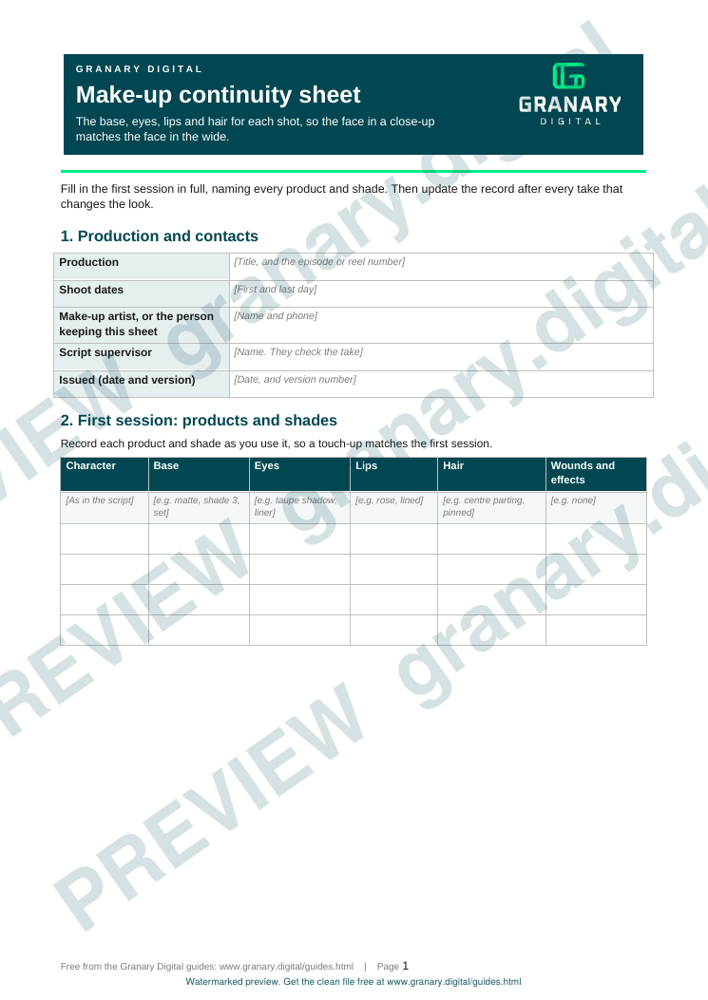
A make-up continuity sheet records the base, eyes, lips and hair for each shot, so the face in a close-up matches the face in the wide. Fill it in at the first session, then after every take.
In short: A make-up continuity sheet records the base, eyes, lips, hair and any wounds or effects for each character in each shot, with photographs of the look. Note the products and shades used, so a touch-up matches the first session. Update the sheet after every take that changes the look, and check the monitor for shine and smudges before the next setup.
What the sheet is for
A close-up and a wide shot taken an hour apart can show a different base, a lipstick that has faded, or hair that has moved. The sheet records the look so the next session starts from the same place. It sits alongside the costume sheet and the continuity log, and the three should agree on the shot numbers.
Get the template
The preview is free to look at and print. For the clean file, without the watermark, put your email in and we will send a download link straight away. You also join From the Barn, our monthly studio email, which you can leave whenever you like.
Open the watermarked preview (PDF)
Done. The download link is on its way to your inbox and works for 7 days. If it has not arrived in a few minutes, check your spam folder.
Columns to fill in
| Column | What to write |
|---|---|
| Scene and shot | The scene and shot number from the call sheet |
| Character | The name as it appears in the script |
| Base | The product, the shade and the finish, such as "matte foundation, shade 3, set with powder" |
| Eyes | The shadow, liner and mascara, with the shades |
| Lips | The product, the shade and whether it is lined |
| Hair | The style, the parting and any flyaways or pins |
| Wounds and effects | Any cut, bruise, prosthetic or effect, with where it is placed |
| State | Sweat, wet hair, smudged lipstick or a fresh touch-up |
| Photos | Reference numbers for the front and the side |
A worked example
A character has a scene in a wet street and a scene in a kitchen, shot on the same day.
- Scene 9, shot 2: "Matte base, shade 3, set. Eyes: taupe shadow, liner on upper lid. Lips: rose, lined. Hair: centre parting, wet and pushed back, two grips above right ear. Photo 9.2."
- Scene 11, shot 1: "As scene 9 but hair dry, one grip removed for the scene. Lips refreshed after lunch. Photo 11.1."
The second line records the change and the touch-up, so the editor can see why the hair differs.
How to use it on set
- At the first session, photograph the look from the front and the side, and record each product and shade.
- After each take, note any change to the state of the look, such as sweat or a smudge.
- Before a new setup, check the sheet and the monitor for shine and for lipstick on the teeth or the cup.
- Repeat the touch-up from the sheet, not from memory.
Common mistakes
- Writing "as before" without naming the products and the shades.
- Recording the look only at the start of the day, then letting touch-ups drift.
- Forgetting the neck and the ears, which show in a wide shot.
- Missing a change to the hair parting or a pinned grip, which a close-up picks up.
- Leaving out the effect used on a cut or a bruise, so the next day starts from a blank.
For a presenter's kit that holds up through a short shoot, the five minute make-up kit is the shorter companion to this sheet.
Related guides
- Make-up for HD and 4K: what the camera sees
- A presenter's five-minute make-up kit
- Make-up for green screen and coves: what to change
- Do we need a make-up artist? A decision guide
- All guides and tools
The picture at the top of this page is an illustration, not a photograph of a client or a real job.
Questions we get asked
What does a make-up continuity sheet record?
The base and shade, eyes, lips, hair and parting, any wounds or effects, and the state of the look such as sweat, wet hair or smudged lipstick, with photographs for reference.
Who fills in the make-up continuity sheet?
The make-up artist fills it in when there is one. On a presenter shoot, the presenter or the producer can keep a simple version, and the script supervisor checks the take.
When do you need a make-up continuity sheet?
When the same person appears in more than one shot, on more than one day, or in a scene where the look changes. A single talking-head piece with one look needs much less.
granary.digital · 01243 884993 · studio@granary.digital · The Old Grainstore, Adsdean, Chichester, West Sussex, PO18 9DN · Prices exclude VAT unless marked inc VAT