

In short: A risk assessment identifies what could cause harm on a shoot, who could be harmed, the controls in place and what more is needed. The HSE's minimum is to identify the hazards, decide how likely and how serious harm could be, then remove or control the risk. This is general guidance; a competent person must assess the actual job.
A risk assessment is a planning tool. Its job is to make the hazards of a shoot visible before anyone is standing under a light.
The HSE's three steps
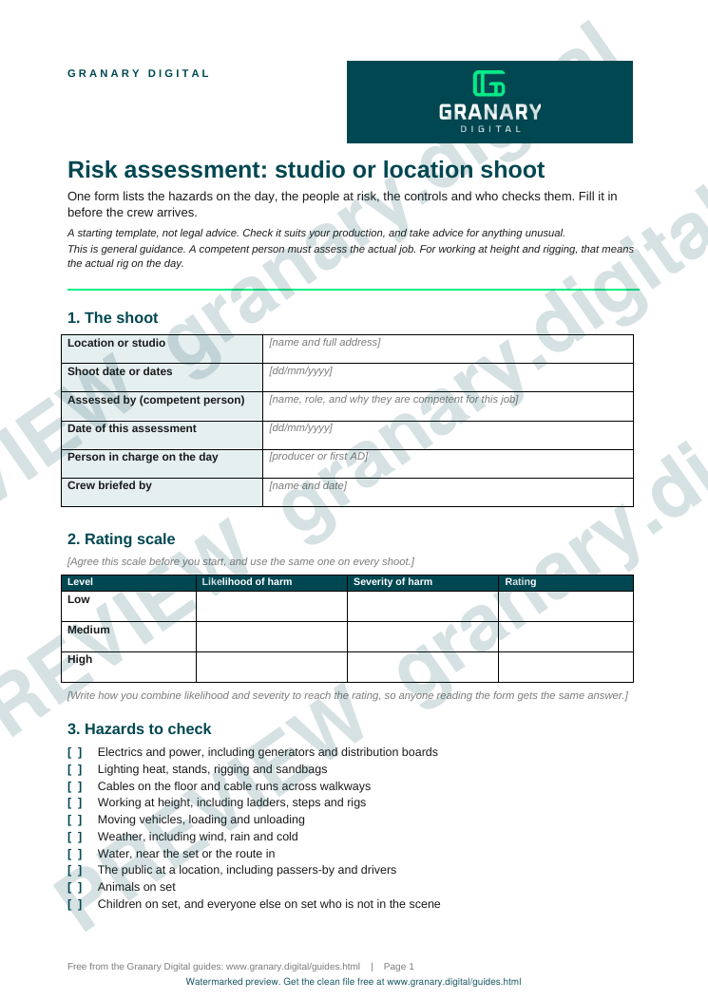
The HSE, citing the Management of Health and Safety at Work Regulations 1999, gives three minimum steps for a risk assessment: identify what could cause injury or illness, decide how likely it is that someone could be harmed and how seriously, and take action to remove the hazard or control the risk. The template's columns follow those three steps.
What the template holds
Columns for the hazard, who could be harmed and how, the controls that exist today, the likelihood, the severity, the rating, any further action, the owner of that action and the date it was done. Agree the rating scale before you start, such as low, medium and high, and use the same scale on every shoot.
Get the template
The preview is free to look at and print. For the clean file, without the watermark, put your email in and we will send a download link straight away. You also join From the Barn, our monthly studio email, which you can leave whenever you like.
Open the watermarked preview (PDF)
Done. The download link is on its way to your inbox and works for 7 days. If it has not arrived in a few minutes, check your spam folder.
How to fill it in, step by step
- Walk the location or review the studio plan with the crew who will work there.
- List the hazards for each activity: lighting, rigging, cable runs, vehicles, weather, public access, animals and children.
- For each hazard, name who could be harmed and how. Be specific: a runner crossing a cable run, not "the crew".
- Write the controls that exist today: a taped cable run, a marked exclusion zone, a check by a competent electrician.
- Rate the risk on your agreed scale.
- Write any further action, name its owner and set the date it must be done by.
- Review the form when the location, the cast, the weather or the plan changes.
Working at height and rain
Working at height and rigging need a competent person to assess the actual rig on the day. The working at height and rigging basics and rain rig safety pages are starting points, not a replacement for that assessment.
A worked example
A location shoot in a public car park, with a vehicle and a light on a stand. The hazards are the stand tipping in wind, cables across the walkway and passers-by. The controls are weights on the stand legs, cable tape and a cordon. The rating is medium. The further action is a second person on the cordon during the vehicle shot, and the owner is the first AD. The form is reviewed when the wind forecast changes.
Common mistakes
- Copying an old assessment without walking the site.
- Writing "be careful" as a control. A control is something you can point to.
- Forgetting the people nearby: the public, drivers and children on a shoot.
- Naming no owner, so nobody checks the action.
- Filing the form and never reviewing it when the plan changes.
For the barn itself, start with the studio safety induction page. The production insurance explained guide covers the cover side, and the call sheet template is where the day's hazards and nearest A&E are passed to the crew.
Sources
- Health and Safety Executive, Risk assessment, read 5 November 2026
Related guides
Questions we get asked
Do I need a risk assessment for a small shoot?
A short one is enough for a simple shoot. The HSE says employers are required by law to protect their employees and others from harm. A risk assessment is the planning step that shows how.
Who writes the risk assessment on a shoot?
The person in charge of the shoot, usually the producer, production manager or first AD, with input from the crew who will do the risky work. A competent person must assess the actual job.
What hazards should a studio or location shoot assess?
Electrics and power, lighting heat and stands, cables on the floor, working at height, moving vehicles, weather, water, the public at a location, and everyone on set, including any children.
granary.digital · 01243 884993 · studio@granary.digital · The Old Grainstore, Adsdean, Chichester, West Sussex, PO18 9DN · Prices exclude VAT unless marked inc VAT