

In short: A shooting schedule orders the scenes so the crew shoots each location and cast group together, not in script order. Build it with a stripboard: one strip for each scene, labelled by location, then move the strips until each shooting day groups the scenes that share a place and people. Check talent, props and wardrobe against each day, leave a buffer, and rebuild the board when the script or availability changes.
A schedule is a plan for the order of work, not for the order of the story. Grouping by place and people is how a day stays within its hours.
What the template holds
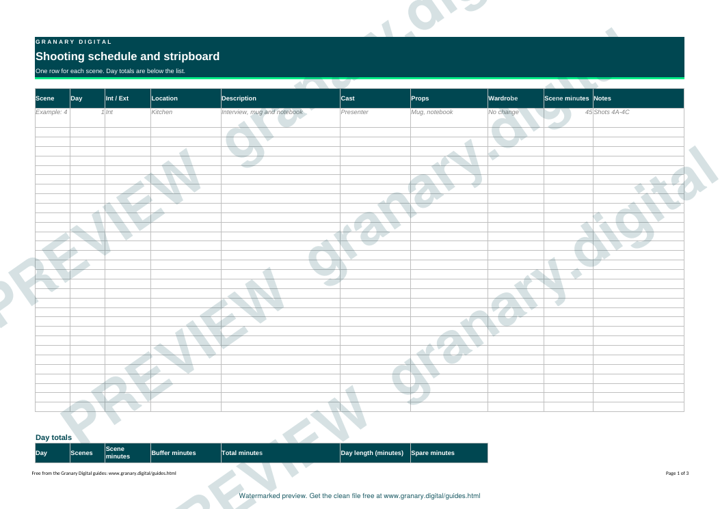
One row per scene: the scene number, interior or exterior, day or night, the location, a short description, the cast, the props, the wardrobe and the day it is booked for. Totals by day sit at the bottom, so an overloaded day shows at a glance.
Get the template
The preview is free to look at and print. For the clean file, without the watermark, put your email in and we will send a download link straight away. You also join From the Barn, our monthly studio email, which you can leave whenever you like.
Open the watermarked preview (PDF)
Done. The download link is on its way to your inbox and works for 7 days. If it has not arrived in a few minutes, check your spam folder.
How to build it, step by step
- Break the script into scenes and number them.
- Write one strip for each scene, with its location and cast.
- Group the scenes by location first. Move the strips until each location is covered in as few blocks as possible.
- Check the talent. Put scenes with the same cast together, and mark any cast member with limited days.
- Check the props and wardrobe. A scene that needs something the day does not have should move.
- Allocate the scenes to days. Leave a flexible scene or a buffer block at the end of each day.
- Copy each day's scenes onto the call sheet.
A worked example
A three-scene short takes place in a kitchen, a hallway and a car park. In script order the crew would move between the three places several times. Grouped by location, the kitchen scenes go first, the hallway scene second and the car park last, on a day when the car is available. The two actors appear in all three scenes, so grouping keeps their booking to one continuous block.
Common mistakes
- Shooting in script order out of habit.
- Ignoring when a cast member can work. One missing actor can move the whole day.
- Scheduling with no buffer, so the first overrun pushes the last scene onto another day.
- Forgetting wardrobe changes and props that need to be made or hired.
- Letting the board drift from the script. Rebuild it when the script changes.
Spaces at the barn book in blocks, not by the hour, except the Green Space and the Grain Hopper. A schedule that groups scenes by room therefore fits how the rooms are booked. The studio spaces page covers the four rooms, and how to plan a studio shoot sets out the steps before the day. The continuity log template keeps the record once the scenes are being shot.
Related guides
Questions we get asked
What is a stripboard?
A board, physical or on a spreadsheet, with one strip for each scene. You move the strips to group scenes by location, cast and day, then read the order off the board.
Should I shoot in script order?
Only when the story needs it or every scene is in the same place. Otherwise scheduling by location and cast saves moves and changeovers.
What does a shooting schedule include?
The day, the scene numbers, the location, the cast, the props and wardrobe for each scene, and the call and wrap times. The schedule feeds the call sheet.
granary.digital · 01243 884993 · studio@granary.digital · The Old Grainstore, Adsdean, Chichester, West Sussex, PO18 9DN · Prices exclude VAT unless marked inc VAT