

In short: A call sheet tells each person when to arrive, where to go, what is being shot and who to call. Issue one for every shoot day, the day before, with call times by department, the address, the nearest A&E, the forecast, the scenes and the contacts. Reissue the whole sheet when anything changes.
A call sheet is the crew's single point of reference for the day. The more people on set, the more it matters that they all have the same one.
What the template holds
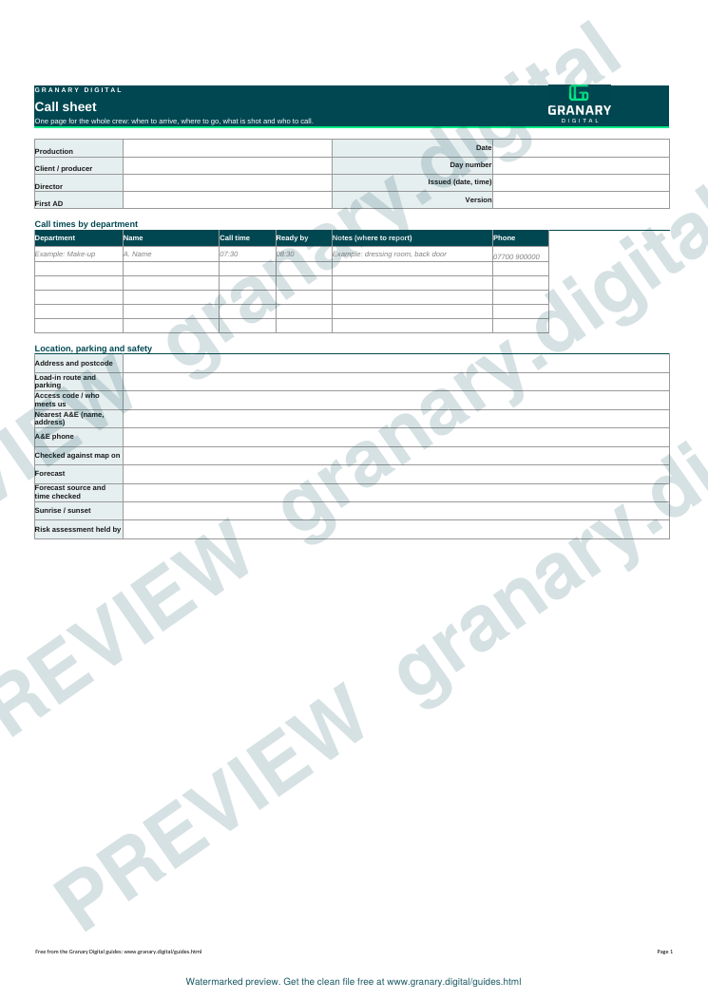
A one-page sheet with a header for the production, the date and the day number. Below it are blocks for call times by department, the location and its nearest A&E, parking and load-in, the forecast, the scenes with cast and props, the contacts and the wrap time. Every field has a label next to it, so a blank is easy to spot.
Get the template
The preview is free to look at and print. For the clean file, without the watermark, put your email in and we will send a download link straight away. You also join From the Barn, our monthly studio email, which you can leave whenever you like.
Open the watermarked preview (PDF)
Done. The download link is on its way to your inbox and works for 7 days. If it has not arrived in a few minutes, check your spam folder.
How to fill it in, step by step
- Fill the header and the day number from the shooting schedule.
- Set call times by department. Work back from the first shot, not from when the first person arrives.
- Add the full address and the load-in route. Note the parking and any access code.
- Find the nearest A&E, add its address and phone number, and check both against a current map.
- Check the forecast from a source you trust on the morning you issue the sheet, and note the time you checked.
- List the scenes for the day, with the cast and the main props for each.
- Add the contacts: the production office, the first AD, the location contact and a backup.
- Issue it, and keep a note of who received it.
Safety
This is general guidance. A competent person must assess the actual job, the site and the hazards before the day, and the call sheet should point to that assessment. The risk assessment template is one place to record it.
A worked example
A two-day shoot in a rented house. Day one: make-up at 07:30, camera and sound at 08:30, talent at 09:00. The address, the parking in the lane behind the house and the nearest A&E all sit on page one. The forecast is checked at 06:45 and shows rain in the afternoon, so the sheet lists the scenes that can be shot indoors first. Day two is issued the evening before, with the change in shot order marked and the earlier sheet withdrawn.
Common mistakes
- Sending the sheet by more than one route, so people hold different versions.
- Setting one call time for everyone. Departments start at different times.
- Leaving the A&E or the parking blank because the location feels familiar.
- Writing the forecast from memory.
- No backup contact, so nobody can answer a question at 6 am.
If you are hiring crew for the day, the film crew hire page explains how Granary crews are booked for the barn. The shooting schedule and stripboard builds the scene list this sheet copies from, and the daily production report records what happened against it.
Related guides
Questions we get asked
What goes on a UK call sheet?
The production name and date, call times for each department, the location and parking, the nearest A&E, the forecast, the scenes and cast being shot, the crew contacts and the wrap time.
Who gets the call sheet?
Everyone on the day, including talent, the client contact, drivers and any extra crew. Send it the day before, and again on the morning if anything has changed.
Do I need a call sheet for a small shoot?
Yes, a short one. Even a two-person shoot benefits from a call time, an address and a contact number on one page, with a short scene list.
granary.digital · 01243 884993 · studio@granary.digital · The Old Grainstore, Adsdean, Chichester, West Sussex, PO18 9DN · Prices exclude VAT unless marked inc VAT