

In short: Film sets use short radio phrases so the crew can pass information quickly: "go ahead" to invite a message, "copy" to confirm you heard, "say again" to ask for a repeat and "standby" to hold. Press, pause, say who you are calling and who you are, then keep it short.
Radios on set are there to move one fact from one person to another with as few words as possible. The cheat sheet gives you the phrases most film and TV crews use, and this page shows you how to use them so you do not clog the channel.
What the cheat sheet is for
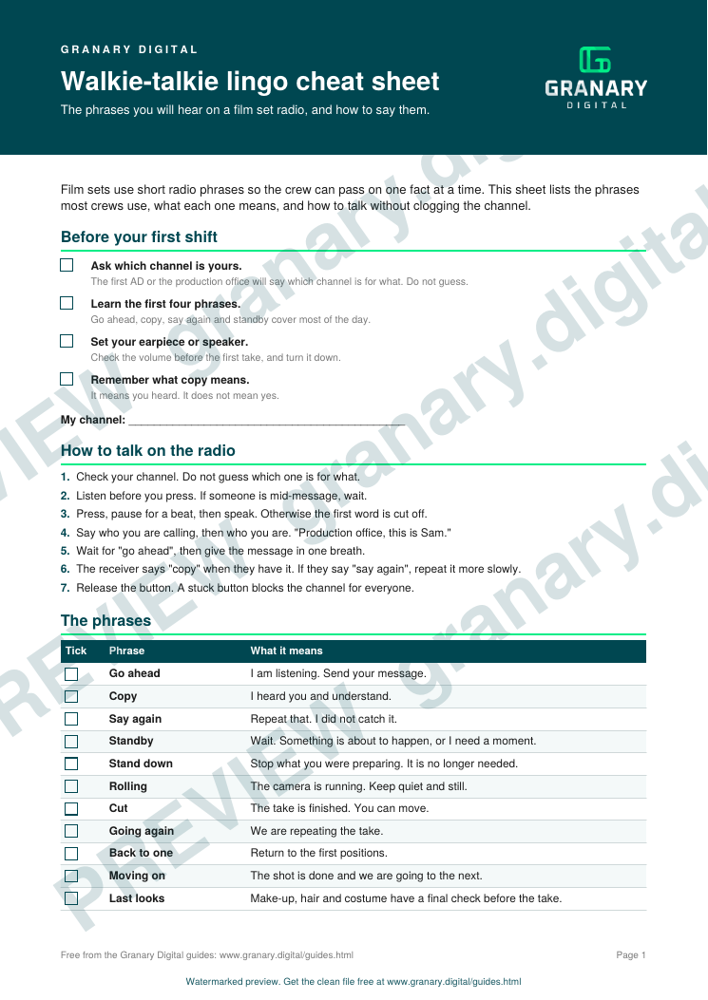
It is one page you can print and put in your pocket on your first days as a runner, trainee or assistant. It lists the common phrases, what each means, and when not to use them. Crews differ, so treat it as a starting point and listen to how your own unit talks.
Get the checklist
The preview is free to look at and print. For the clean file, without the watermark, put your email in and we will send a download link straight away. You also join From the Barn, our monthly studio email, which you can leave whenever you like.
Open the watermarked preview (PDF)
Done. The download link is on its way to your inbox and works for 7 days. If it has not arrived in a few minutes, check your spam folder.
How to use it
- Check your channel. The first assistant director or the production office will tell you which channel is for what. Do not guess.
- Listen before you press. If someone else is mid-message, wait.
- Press, pause for a beat, then speak. Otherwise the first word is cut off.
- Say who you are calling, then who you are. "Production office, this is Sam."
- Wait for "go ahead". Then give the message in one breath.
- Confirm. The receiver says "copy" when they have it. If they say "say again", repeat it more slowly.
- Release the button. A stuck button blocks the channel for everyone.
The phrases
| Phrase | What it means |
|---|---|
| Go ahead | I am listening, send your message |
| Copy | I heard you and understand |
| Say again | Repeat that, I did not catch it |
| Standby | Wait, something is about to happen or I need a moment |
| Stand down | Stop what you were preparing, it is no longer needed |
| Rolling | The camera is running, keep quiet and still |
| Cut | The take is finished, you can move |
| Going again | We are repeating the take |
| Back to one | Return to the first positions |
| Moving on | The shot is done and we are going to the next |
| Last looks | Make-up, hair and costume have a final check before the take |
| Wrap | The day or an element is finished |
| On my way | I am heading to you now |
| Go to a private | Move to another channel to talk |
| Eyes on | I can see the person or thing in question |
Some of these are set calls, such as "rolling", which the first assistant director controls. Do not say them yourself unless you have been asked to.
A worked example
You are a runner and the make-up artist needs the actor on set. You press, pause and say: "Floor, this is Sam." The floor runner answers: "Go ahead." You say: "Make-up is ready for last looks, actor to set please." They reply: "Copy, bringing them now." Two clean exchanges, no chatter, and the first assistant director has the information without hearing a long story.
Common mistakes
- Talking over a take. If you hear "rolling", stop transmitting unless it is urgent.
- Long messages. If it needs more than two sentences, ask the person to call you or go to a private channel.
- Saying "copy" for a yes. It means you heard, not that you agree.
- Naming people or money on an open channel. Anyone with a radio can listen, so keep private matters off it.
- Leaving the radio loud in a quiet scene. Use an earpiece, and turn it down before a take.
Planning a shoot of your own? A call sheet tells the crew who is where and when, and the shooting schedule keeps the radio traffic predictable. When you need crew on the day, Granary can supply them.
For the money side, see crew rates explained, and the crew deal memo covers agreeing terms.
Related guides
Questions we get asked
What do "copy" and "go ahead" mean on a walkie-talkie?
"Go ahead" invites the caller to speak. "Copy" means you have heard and understood. Neither means yes to a request, so say "yes" or "no" when you are answering a question.
What are the main walkie-talkie phrases used on film sets?
The ones you will use daily are go ahead, copy, say again, standby, roger that or understood, and "on my way". The cheat sheet also covers calls for rolling, cut, resetting and wrap.
Should a runner say "over" on a film set?
Rarely. Most crews drop it and use short sentences. Say who you are calling, then who you are, then the message. Always check the radio channel you have been given.
granary.digital · 01243 884993 · studio@granary.digital · The Old Grainstore, Adsdean, Chichester, West Sussex, PO18 9DN · Prices exclude VAT unless marked inc VAT