

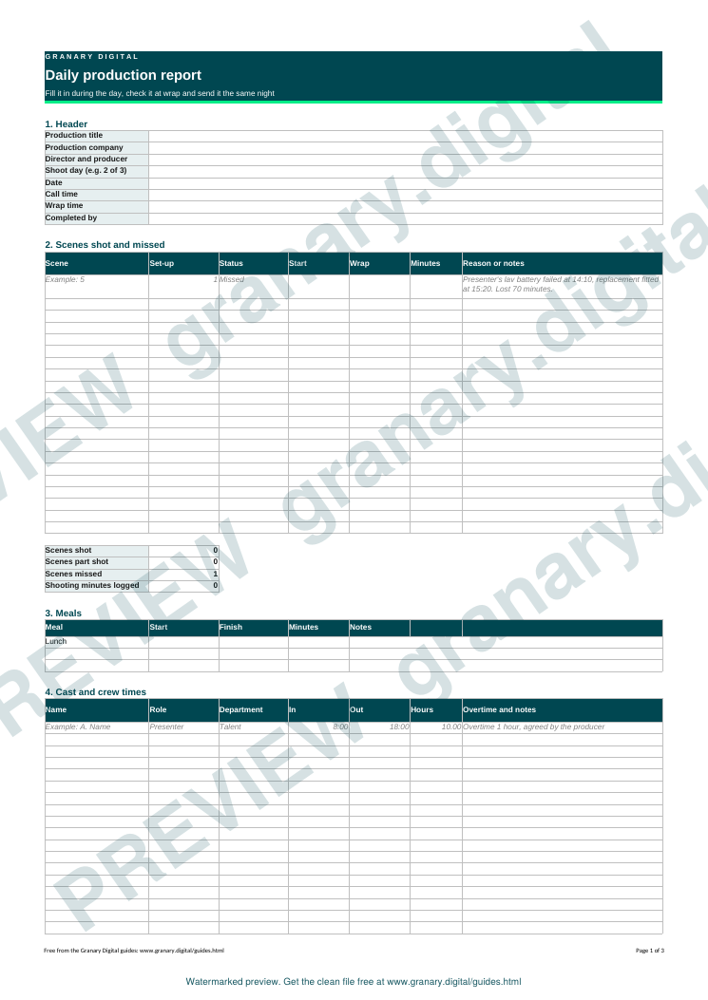
In short: A daily production report, or DPR, records one shoot day: scenes shot and missed, call and wrap times, cast and crew on set, equipment used and any incidents. Production uses it to track progress and cost, and it is filed as a permanent record. Fill it in during the day, check it at wrap and send it the same night.
A daily production report tells the next morning's team what happened the day before. Get the times and the reasons down while they are fresh, because a report written from memory at wrap is where small errors come from.
What the report is for
The report is the production's daily record. It shows progress against the schedule, it records what the day cost in time, and it lets the next day start from fact rather than from what someone remembers.
Get the template
The preview is free to look at and print. For the clean file, without the watermark, put your email in and we will send a download link straight away. You also join From the Barn, our monthly studio email, which you can leave whenever you like.
Open the watermarked preview (PDF)
Done. The download link is on its way to your inbox and works for 7 days. If it has not arrived in a few minutes, check your spam folder.
What goes on the report
- Header: the production title, the production company, the director and producers, the shoot day (day 3 of 5, for example) and the date.
- Script notes: the scenes and pages shot, each scene missed with its reason, and the lunch time.
- Camera and sound: the cards, rolls or files used, with a note of any material lost or unusable. The camera report holds the detail.
- Cast and crew: in and out times, meal times and any overtime for each person, grouped by department.
- Equipment and incidents: kit hired in, anything late or damaged, and any accident, theft or weather problem.
How to fill it in
- Before the call, copy the header from the call sheet and list the scheduled scenes in the order of the shooting schedule, so the report matches the plan.
- Log each scene's start and wrap time as it happens, not from memory.
- At each meal, record the time against each person's name.
- At wrap, count the scenes shot and missed, and check that every missed scene has a reason.
- Collect the figures from the heads of camera, sound, lighting and grip before you leave.
- Send the copies that night, so the production office can check them before the next call.
A worked example
On day 2 of a three-day interview shoot, scenes 4A and 4B were shot in the first two setups. Scene 5 was missed. The entry reads: "Scene 5 not shot. Presenter's radio mic failed at 14:10, replacement sent from the hire company and fitted at 15:20. Lost 70 minutes." The next morning's call sheet moves scene 5 to the first setup, so the day starts with the scene the team already knows about.
Common mistakes
- Writing the report at wrap from memory, so the in and out times come out rounded to the nearest hour.
- Listing a scene as shot when only a take was rolled and nothing usable was kept.
- Leaving missed scenes without a reason, which leaves the next day's schedule to guesswork.
- Forgetting hired kit that came back late or damaged.
- Sending the copies to one person only.
Sources
- Wikipedia, Daily production report, read 5 November 2026
Related guides
Questions we get asked
Who fills in a daily production report?
On UK sets the 2nd assistant director usually compiles it, working from the script supervisor's notes and figures from each department during the day. The production manager and the production office check it the next morning.
Is a daily production report the same as a call sheet?
No. A call sheet tells the crew what happens tomorrow, where and when. The daily production report records what happened today.
Why does the report matter after the shoot?
It is filed as a legal record of the shoot, so its times and reasons need to be accurate and dated. A report that says why a scene was missed is far easier to defend than one that leaves a gap.
granary.digital · 01243 884993 · studio@granary.digital · The Old Grainstore, Adsdean, Chichester, West Sussex, PO18 9DN · Prices exclude VAT unless marked inc VAT